Resonance Unmoored
2025
Experience Design | Game Design
Resonance Unmoored is a hybrid mixed reality game combining physical and spatial interactions and digital augmentation to explore how cooperation and verification can rebuild shared understanding through discovering the truth collaboratively.
Project OverviewResonance Unmoored is a hybrid cooperative narrative game that unfolds across its players’ sensory fragmented perspectives.
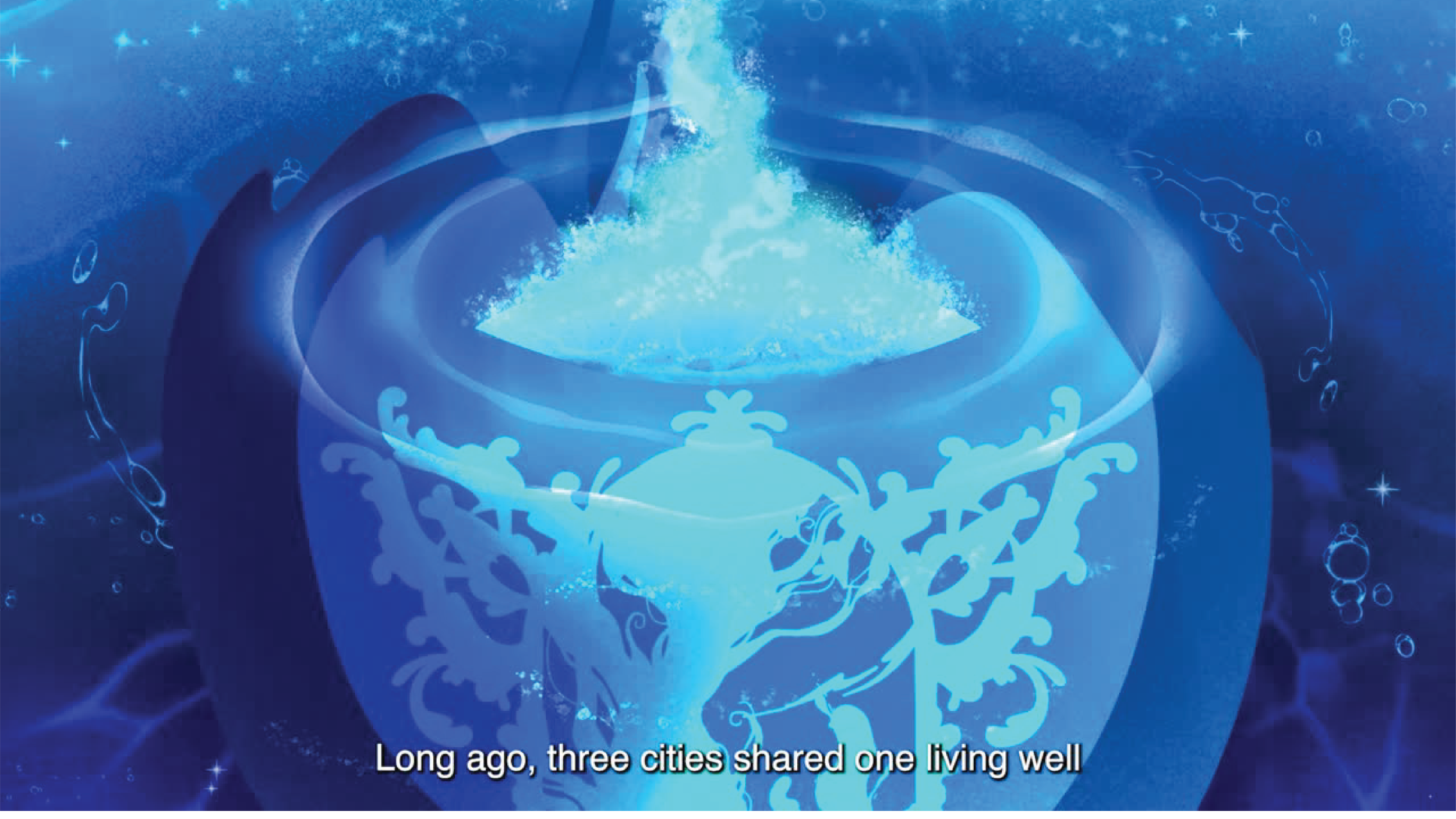
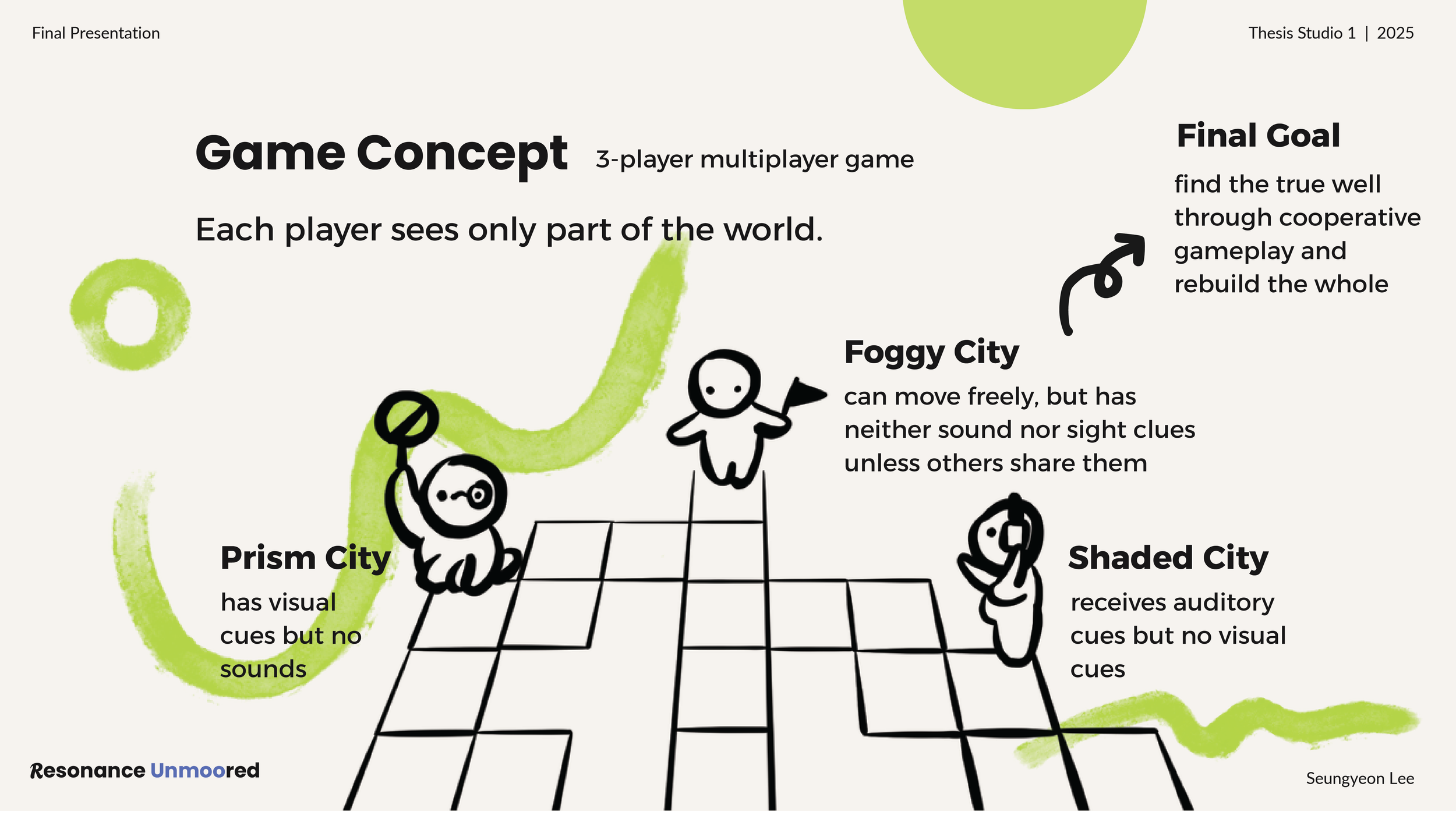
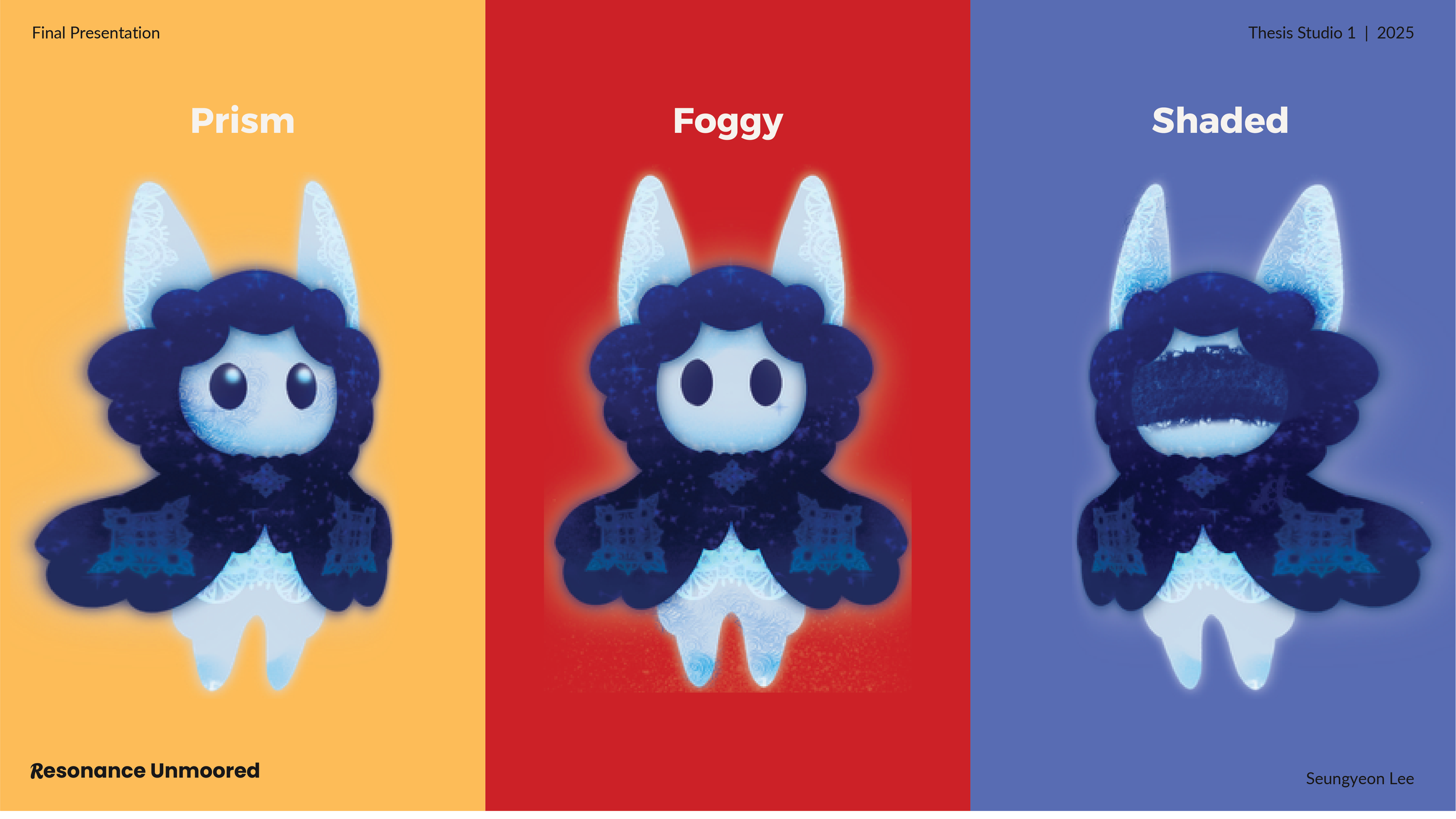
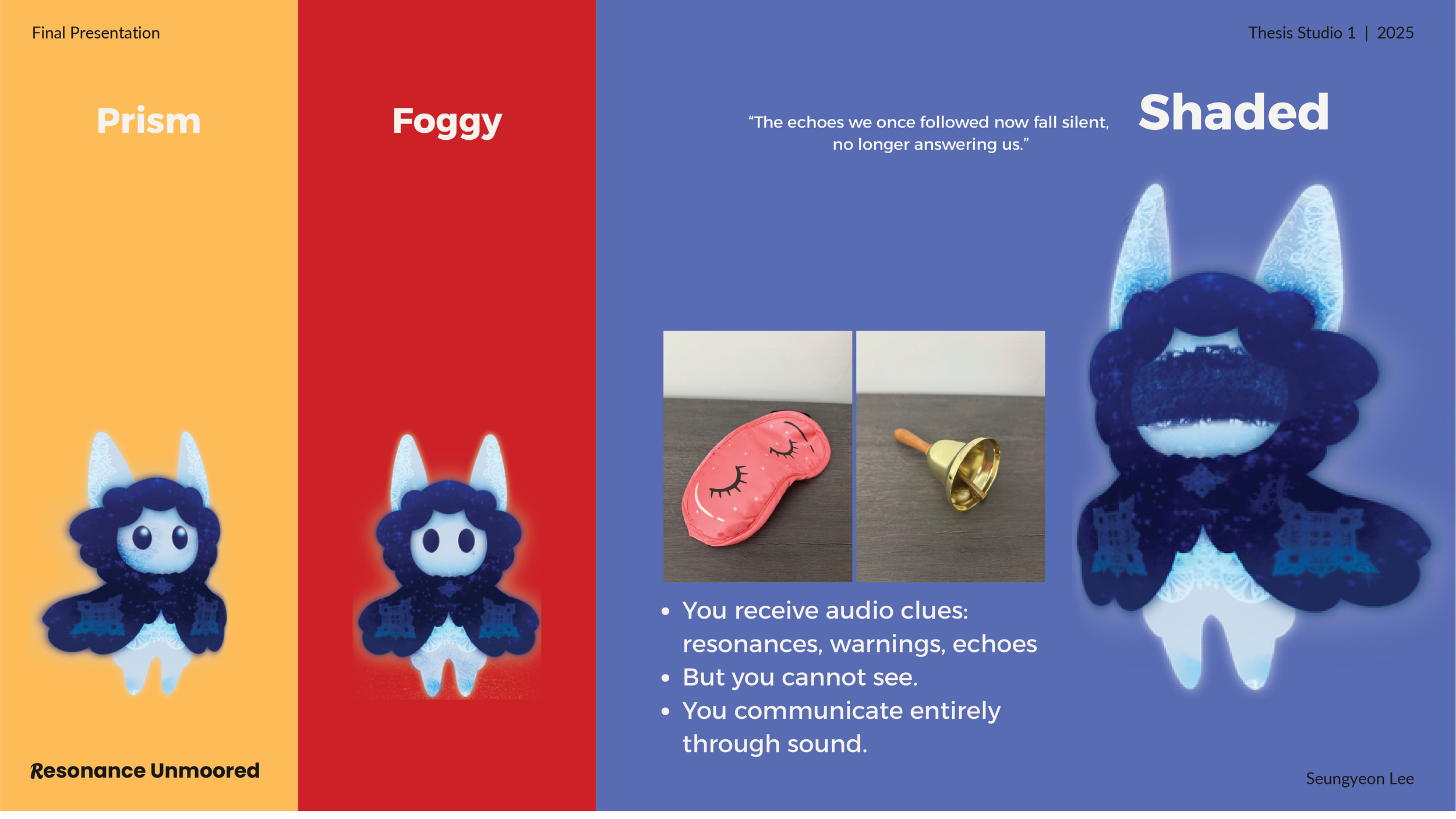
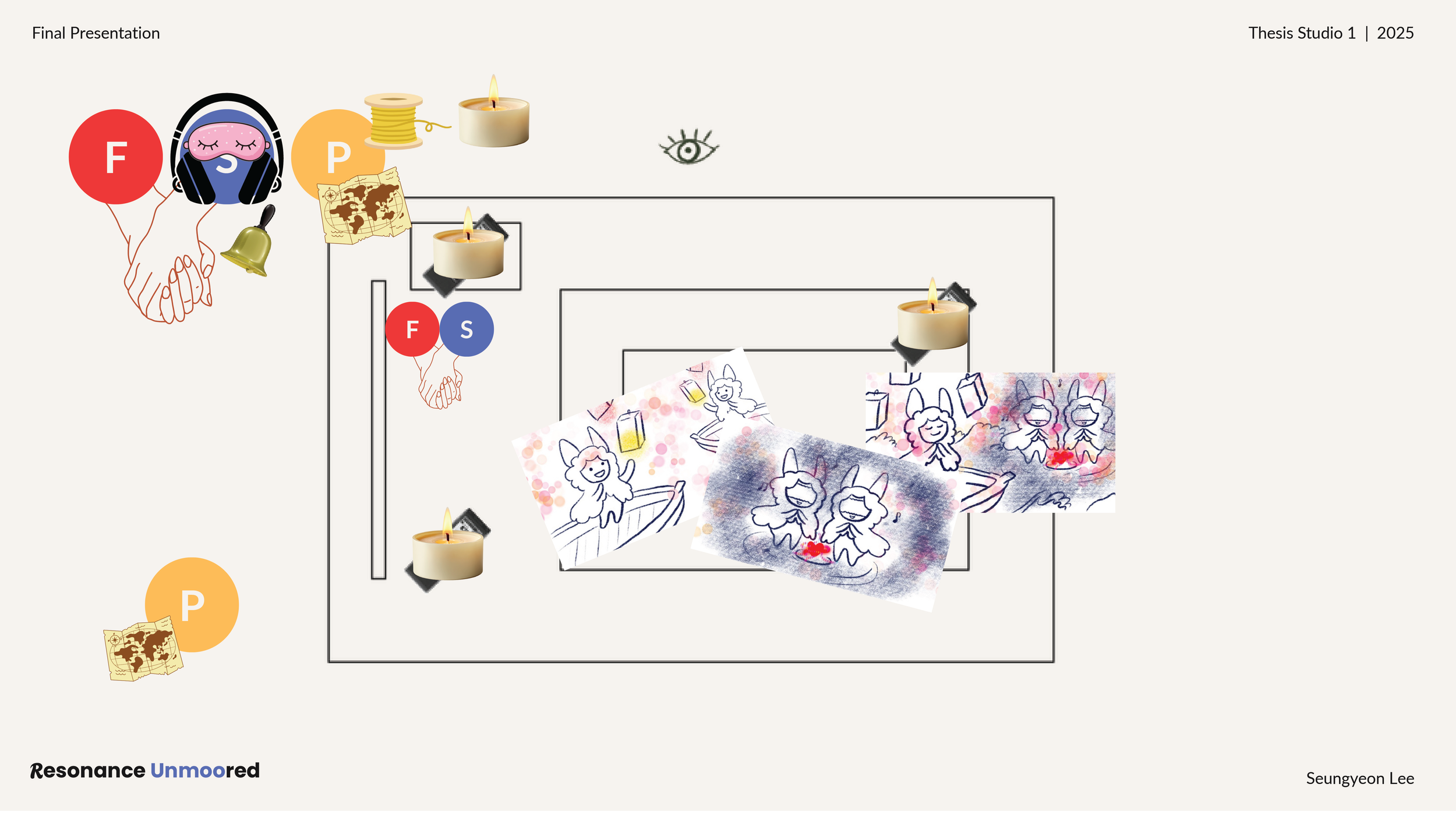
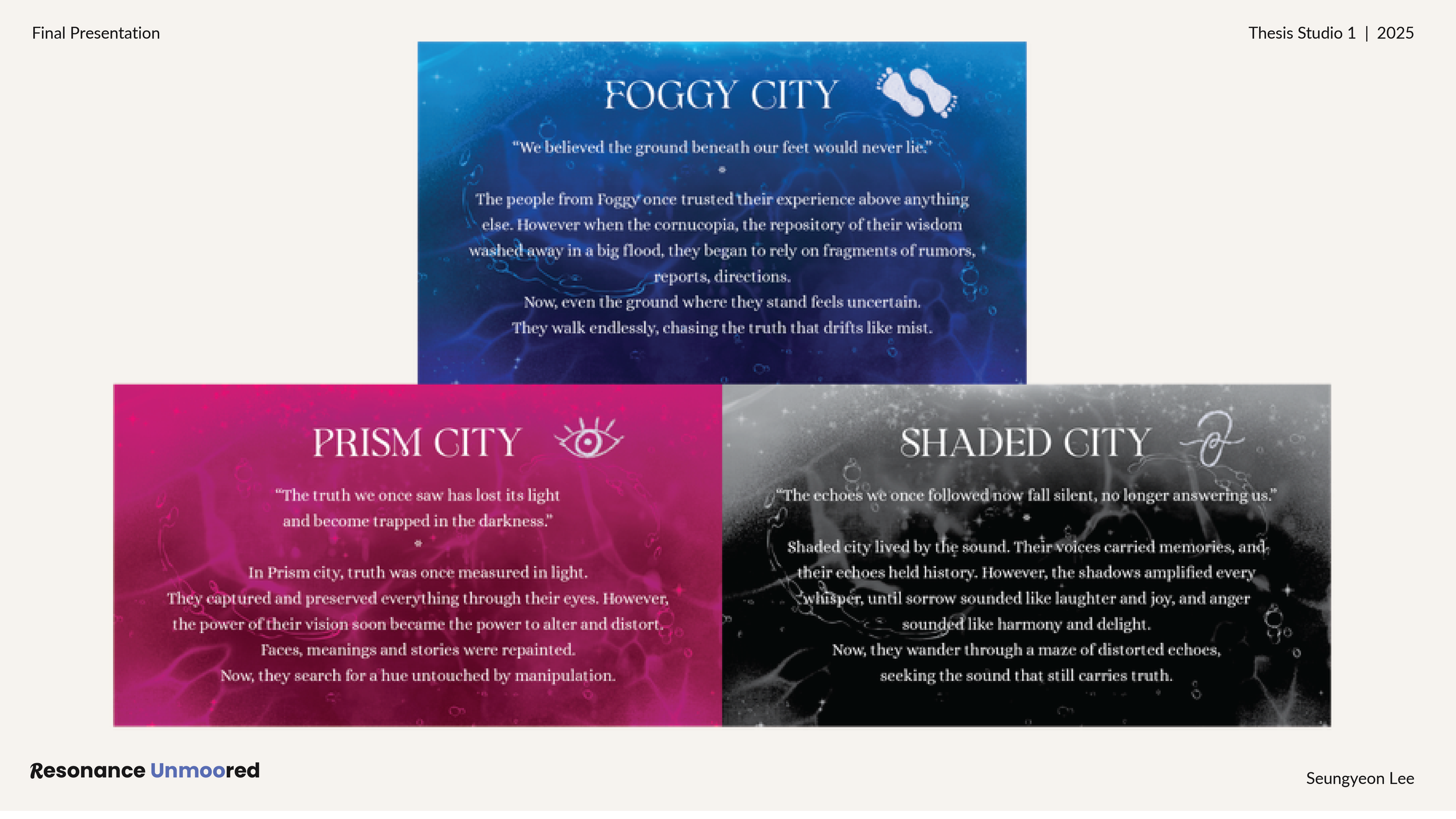
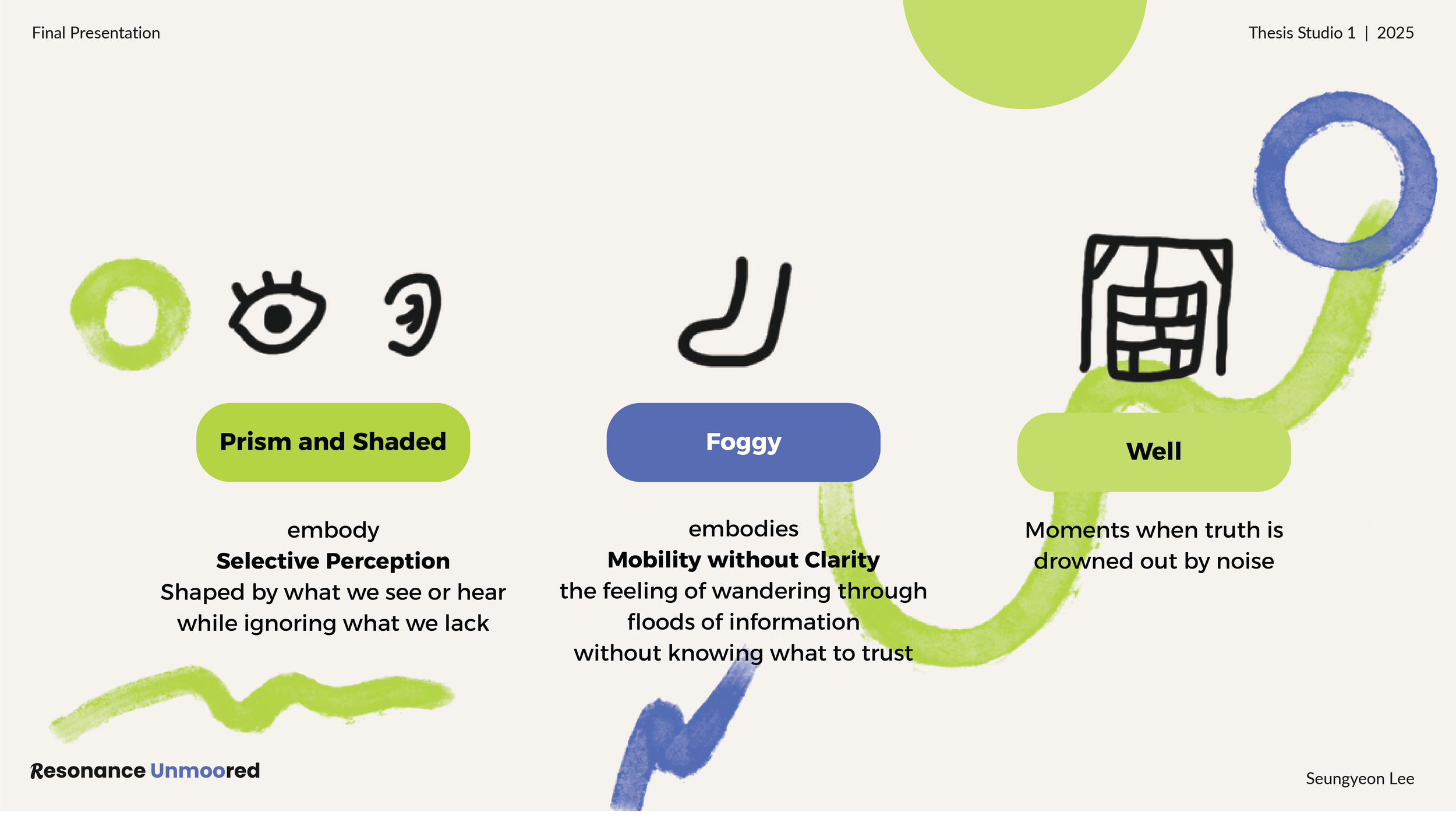
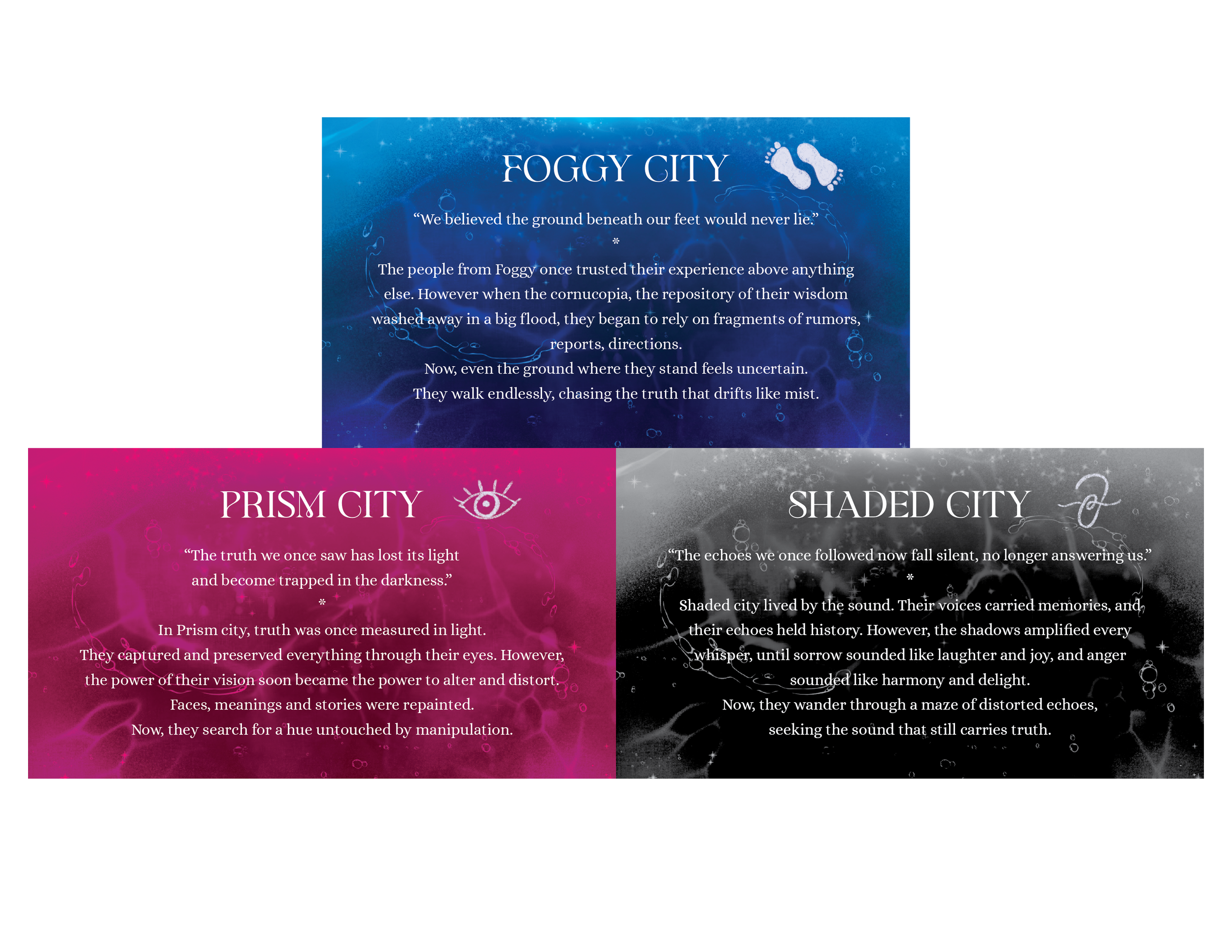
Three players take on the persona and role of each city: Foggy, Prism, and Shaded. Foggy can move freely around the space and can communicate with all senses. Prism can see everything, but hear nothing. They can only communicate through visuals. Lastly, Shaded receives auditory and sound cues, but sees nothing. A shaded player can only communicate through sounds and their voice. The players from Prism and Shaded are the ones who have the information and meaning of the space, but to communicate, they need the Foggy player to translate each other’s language. While set in a poetic examination of how people listen, verify, and connect in a fractured world, the project asks players to navigate a shared space where no single perspective nor story grants access to the truth. Instead, players can only piece together fragments of information and truth through collaboration, negotiating uncertainty, and uncover the resonance well, which is the symbolic heart of the harmony of the cities, whose silence threatens the landscape of their world.
The project blends VR-based spatial navigation and physical, sonic interaction via Arduino and Unity, creating embodied experiences of information asymmetry. Each player carries unique limitations in sensory and communication, one can see but not hear, another can hear but not see, and one can move freely but lacks direct access to sensory information of the space. These constraints are not just obstacles to challenge the players, but design values, crafted to mirror how mediated experiences shape our understanding in contemporary society.
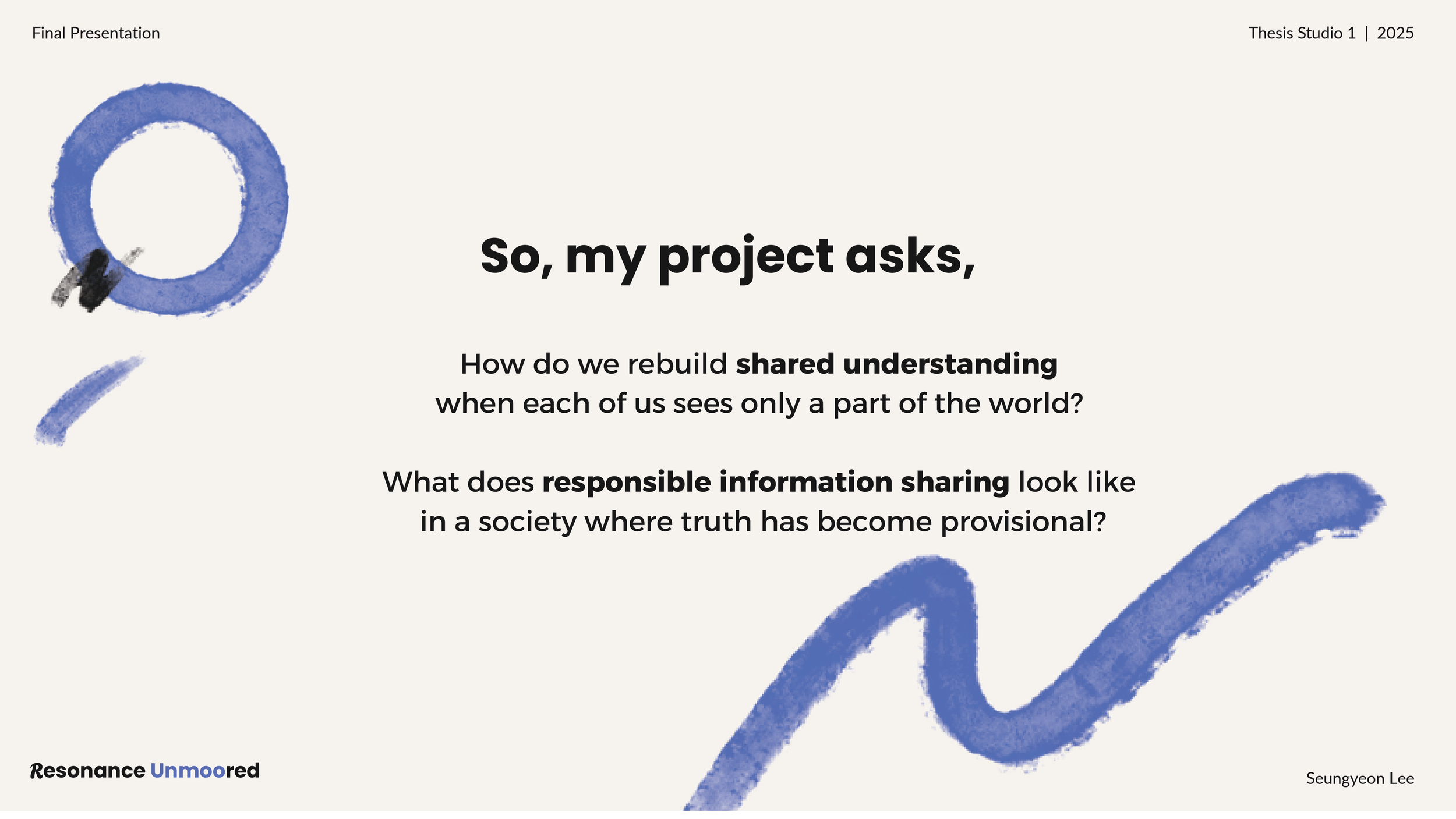
By positioning players in asymmetrical roles and limiting their channels of communication, the game becomes a reflective space, an experiment in collective inference, trust building, and critical verification. Resonance Unmoored ultimately asks: When shared understanding fractures, how might we restore trust and piece together meaning, in the middle of the overwhelming currents of the information age? How are you engaging with the information in your real life?
Prototype 1
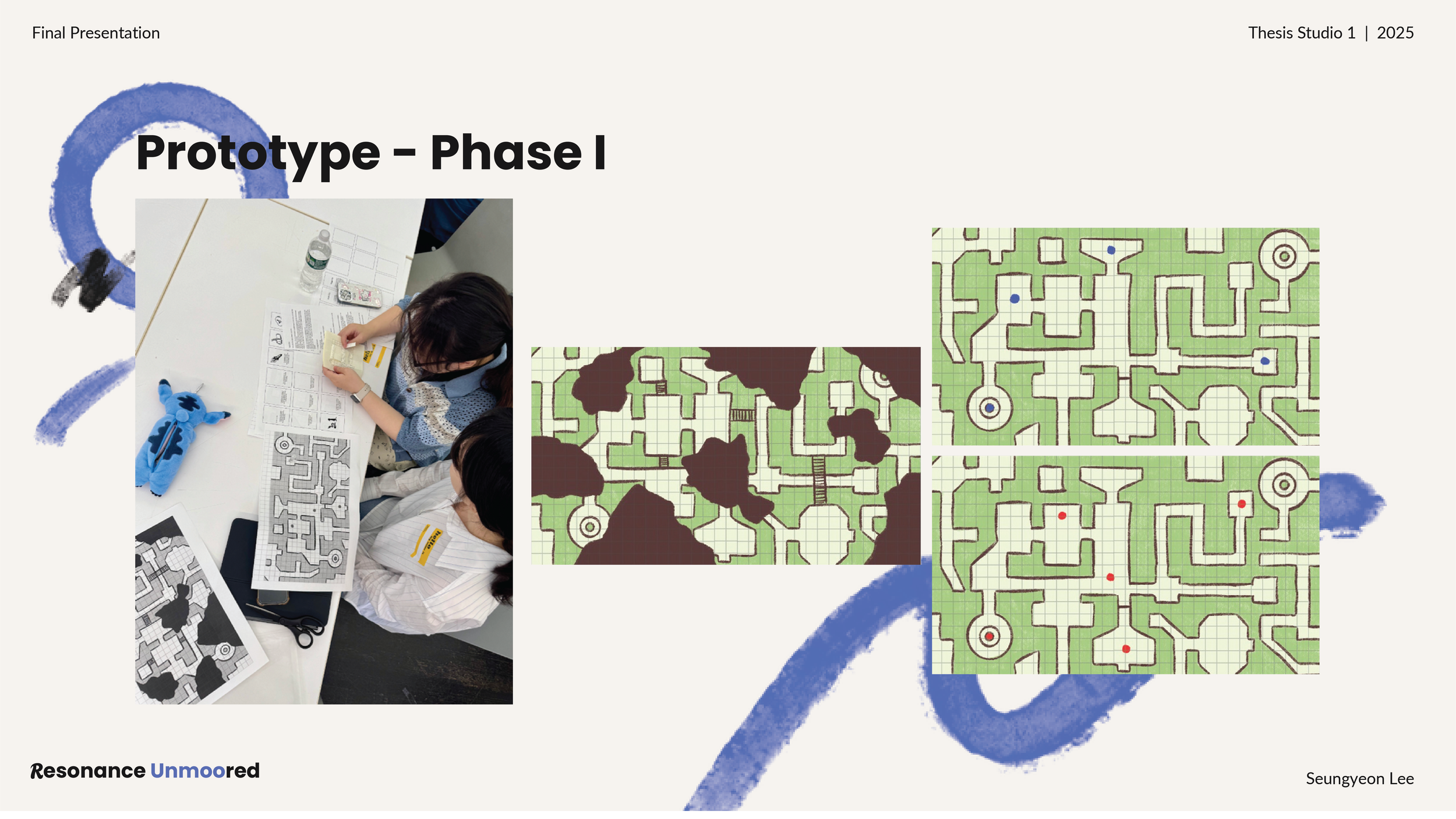
At the first phase, I was imagining this game to be in a board game format. The format of the prototype for the project is a collaborative deduction puzzle board game about unequal access to information and the responsibility of sharing it. This game is about exploring how inequality in access to information shapes our choices and responsibilities. Players are placed in three different cities with different constraints and ways of life.
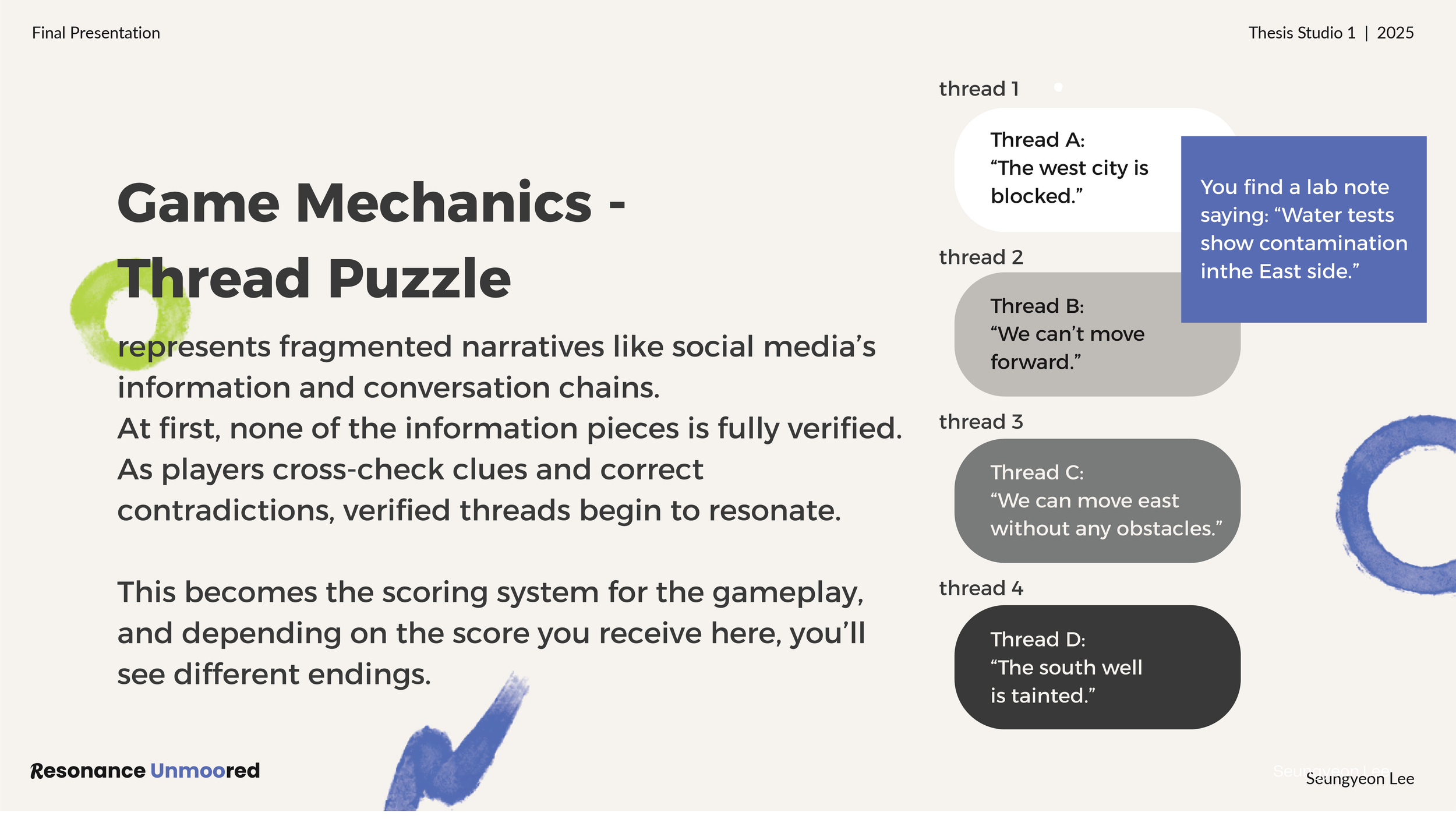
The challenge is not just in finding and solving the problem but in how information is exchanged, verified, and trusted. Every act of examining and comparing is going to cost other values, reminding us that in real life, verifying information takes time, energy, and resources. However, by engaging with effort and responsibility, this game suggests how we might better approach information in today’s world. The goal is to solve the issue, but also to reflect on a deeper truth: information is never just consumed, but it always comes with the great weight of responsibility.
The primary focus of my phase 1 prototype was to test whether the message is conveyed effectively and whether it prompts players to reflect on the project’s main theme while playing. I also wanted to test if the overall plot and instructions of the game are clear enough for players to understand without needing additional guidance beyond what is provided in the rule book.
Prototype 2
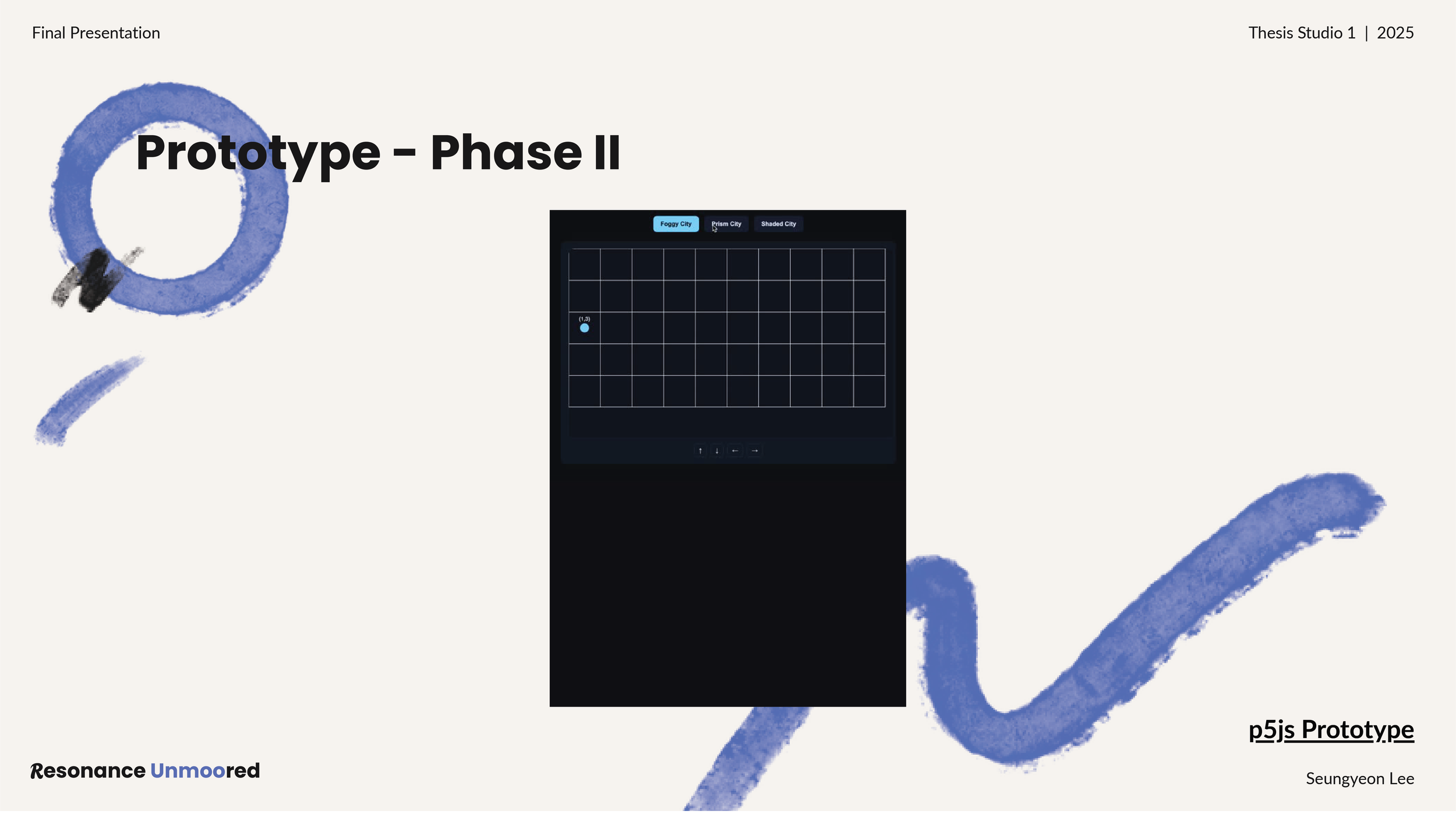
After testing the first prototype, I got feedback on the format of the game. While thinking about the narrative structure that I’ve built for the game, I was thinking about the contents that can be applied to the game that will make the narrative stronger. Players also suggested I could try making a real-world game or some other game genre that might make it more immersive. Then I started to add the distortion system when the players share information and add experiences in the game. For this phase, I started building a prototype in p5.js to visualize the things that will happen in the game.
Prototype 3
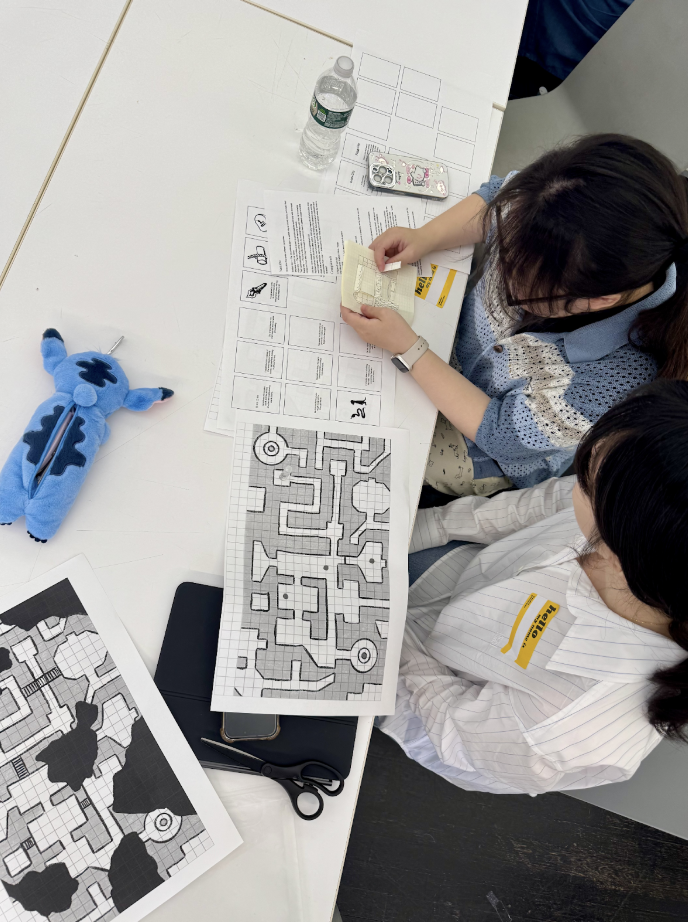
For this iteration, I tested the game physically using printed instructions, tangible game materials, and non-spatial audio. As I considered how to make the gameplay more immersive, my initial idea was to place players in separate rooms and restrict communication digitally. However, to create a richer sense of collaboration and interdependence, I ended up deciding to keep all players in the same space while enforcing their sensory limitations through physical tools. While working on it, I also thought about how to build a more narrative about how each city started to distrust the other, to represent the digital media where we can’t believe the information that comes from one another. Alongside it, I added a room where players have to discover the stories behind the game as a backdrop, where they have to interpret each clue given to each city, and find the corresponding game item.
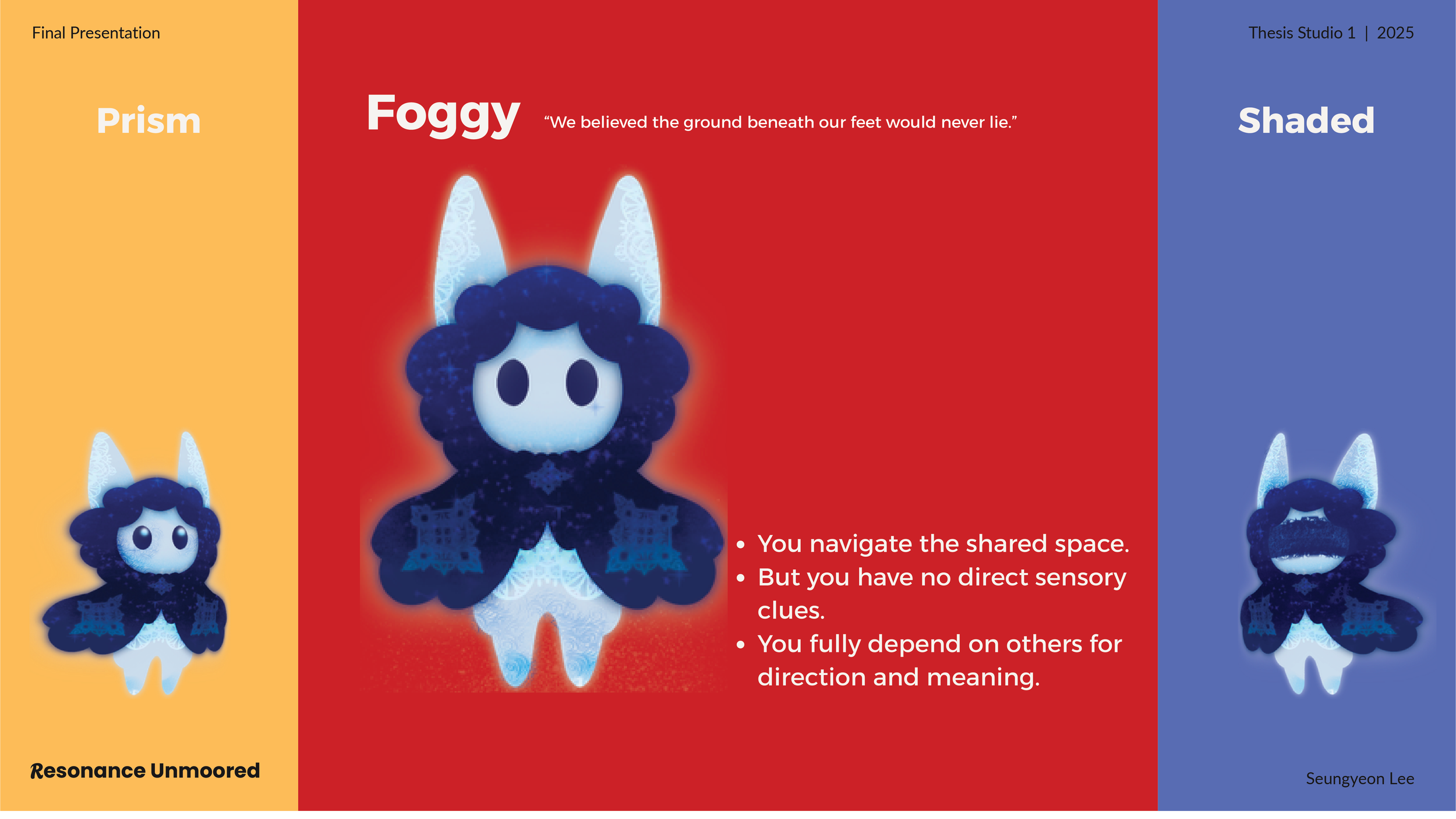
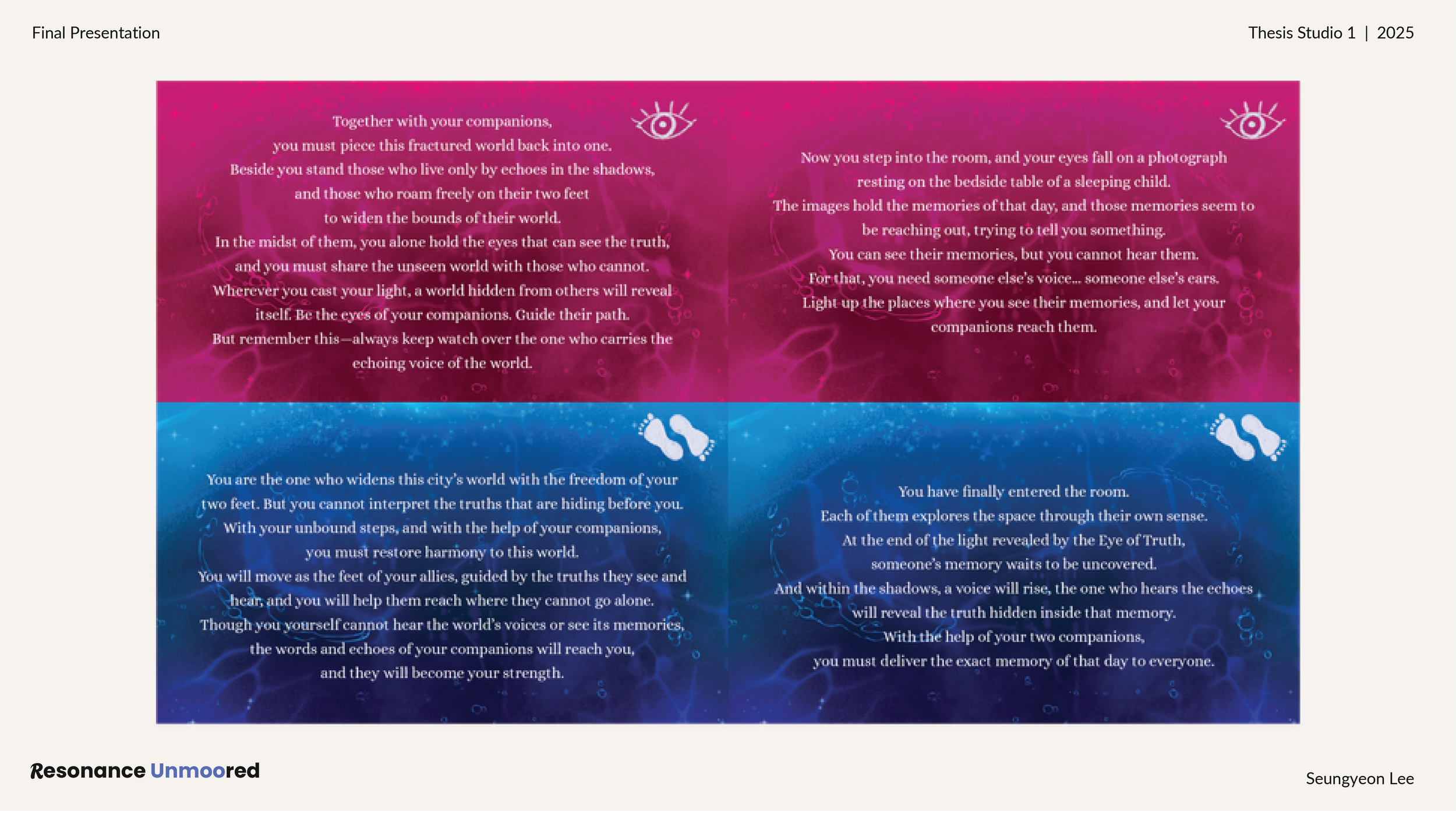
For the Foggy player, they are the only ones who can freely navigate the environment, but begin with no information about the space. Their version of the world contains only the basic structure without any visual or auditory clues. All their cues must be obtained through the other players. Since the Foggy players are the only ones who can receive and use all senses, they become the bridge between Prism and Shaded players to share information.
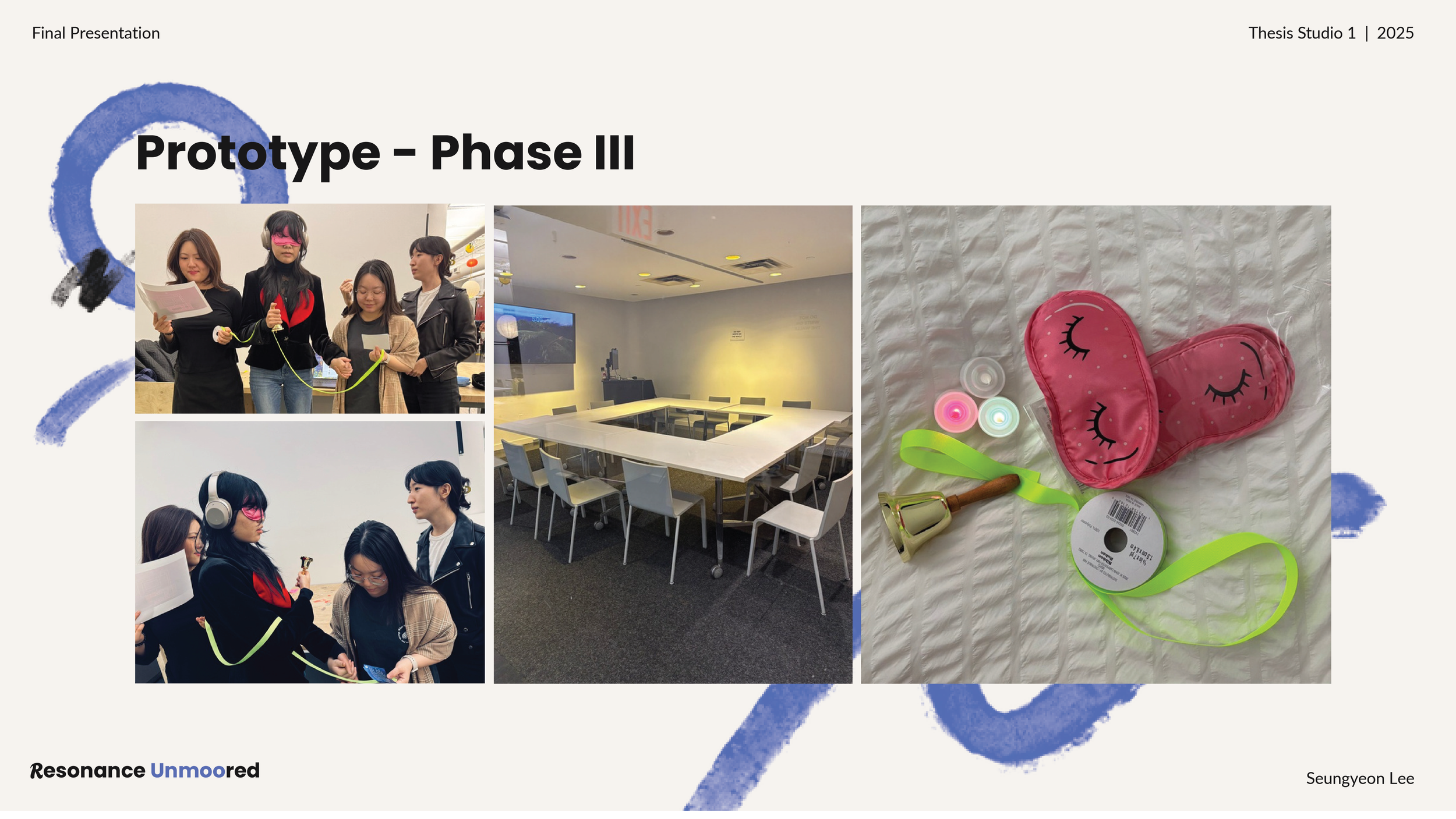
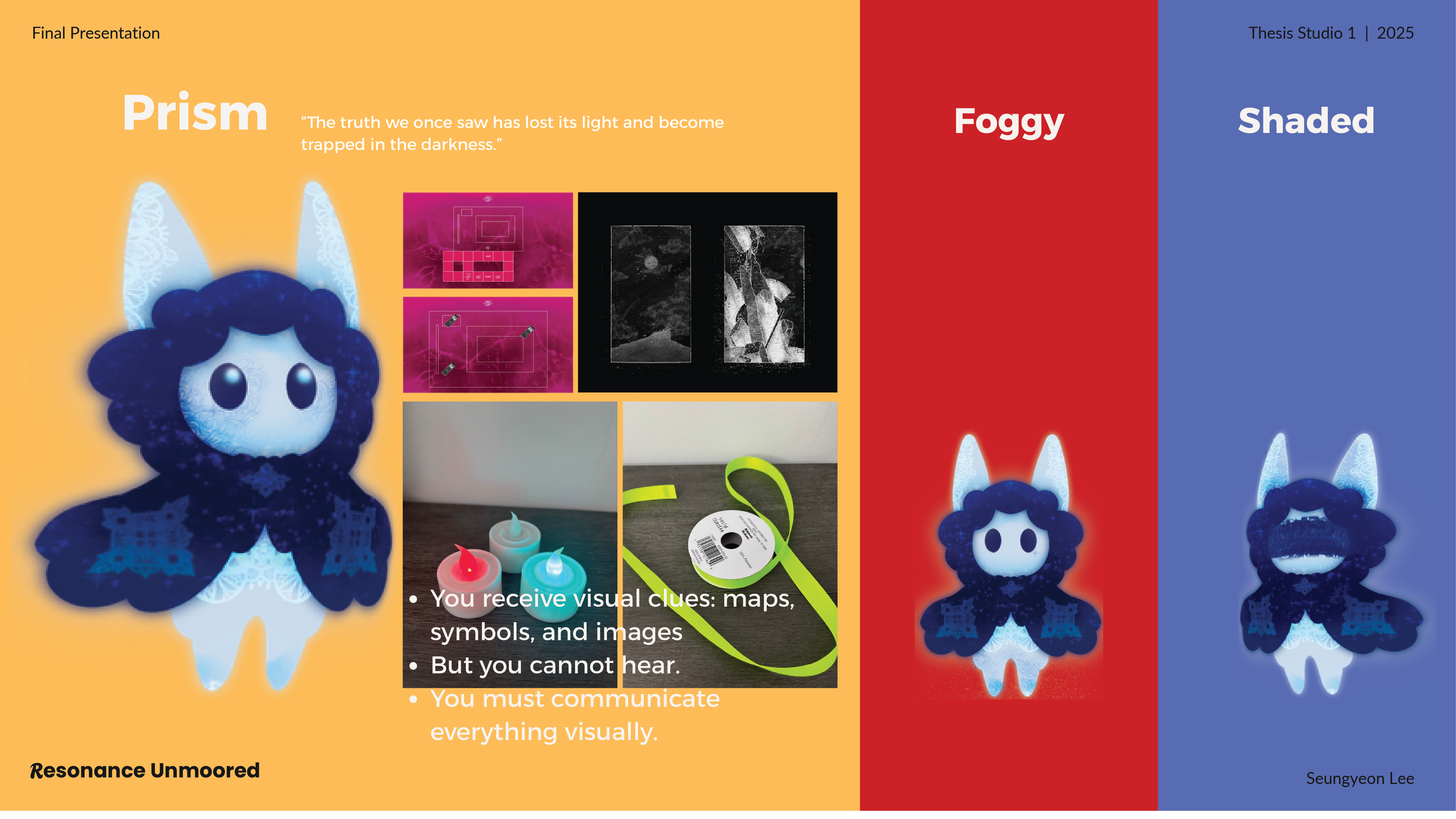
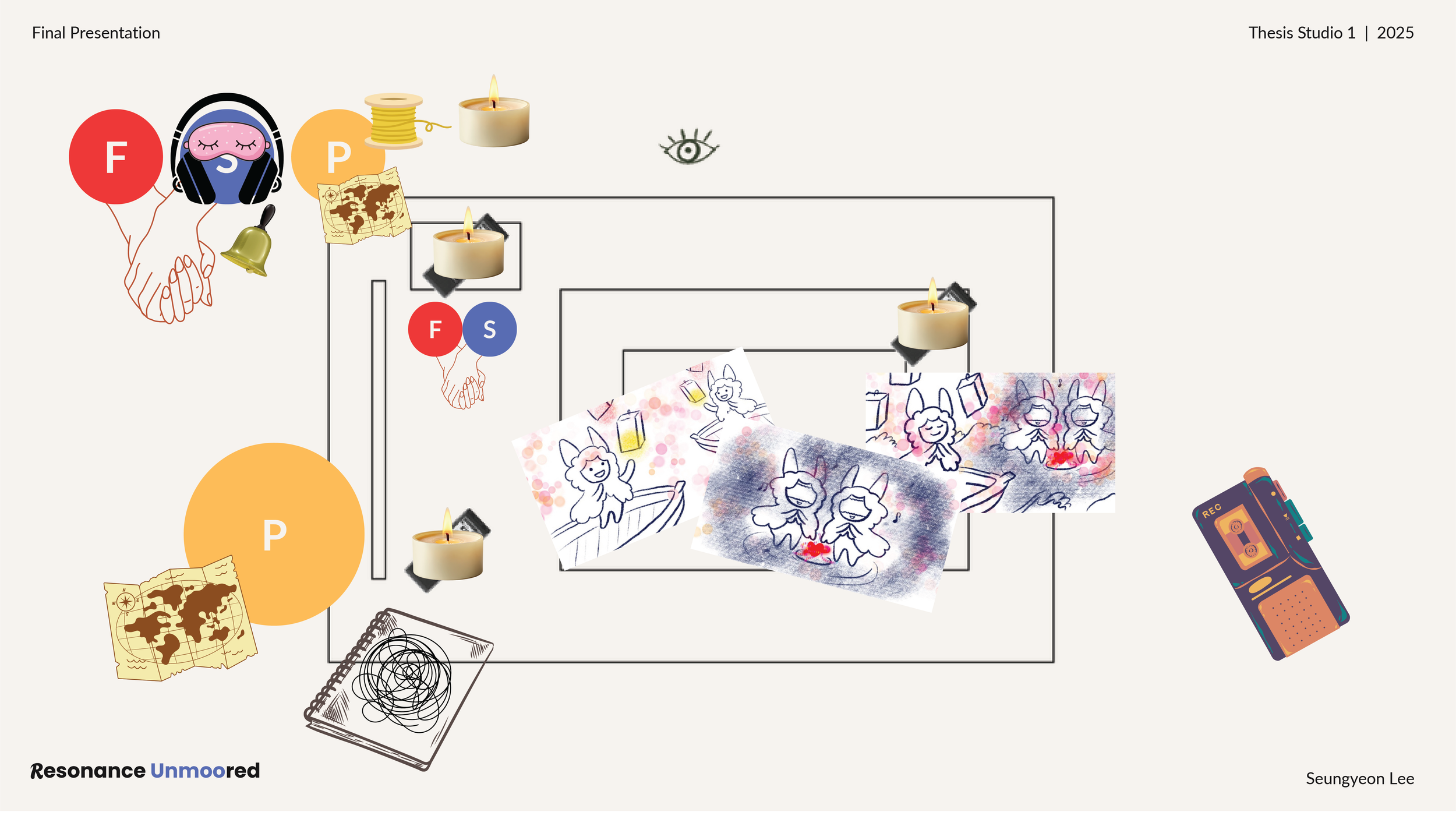
For the Prism player, I restricted their hearing by having them cover their ears. I gave them a map of the space showing pathways and the scattered objects that other players must find. They also received long, neon-colored grosgrain ribbons, which they could use to mark safe or discovered paths for the team. They can communicate with their body language, sketches, and all visual information with the Foggy player.
For the Shaded player, I restricted their vision by having them wear a sleep mask and made them wear headphones that play instructions and audio cues triggered when they reach certain locations. I also provided a wooden handle liberty bell that they could ring toward different directions to listen for the space’s acoustic response. The Shaded player’s bell is not simply an aesthetic prop; it is their core sensory interface with the world. Since their vision is fully restricted, the only way they can perceive spatial information, locate clues, or detect distorted signals is through directional resonance with the space. By ringing the bell toward different directions, they generate echoes that return uniquely depending on distance and obstacles. These echoes become a navigational and communicative vocabulary for the Shaded player, and also make it easy for the Prism player to know which way they are receiving the information. Just as Prism communicates visually and Foggy navigates physically and translates each player’s language, Shaded must listen to the space to sense what others cannot. Their directional bell ringing is therefore both a sensory mechanism and a communication tool, one that reveals information no other player has access to.
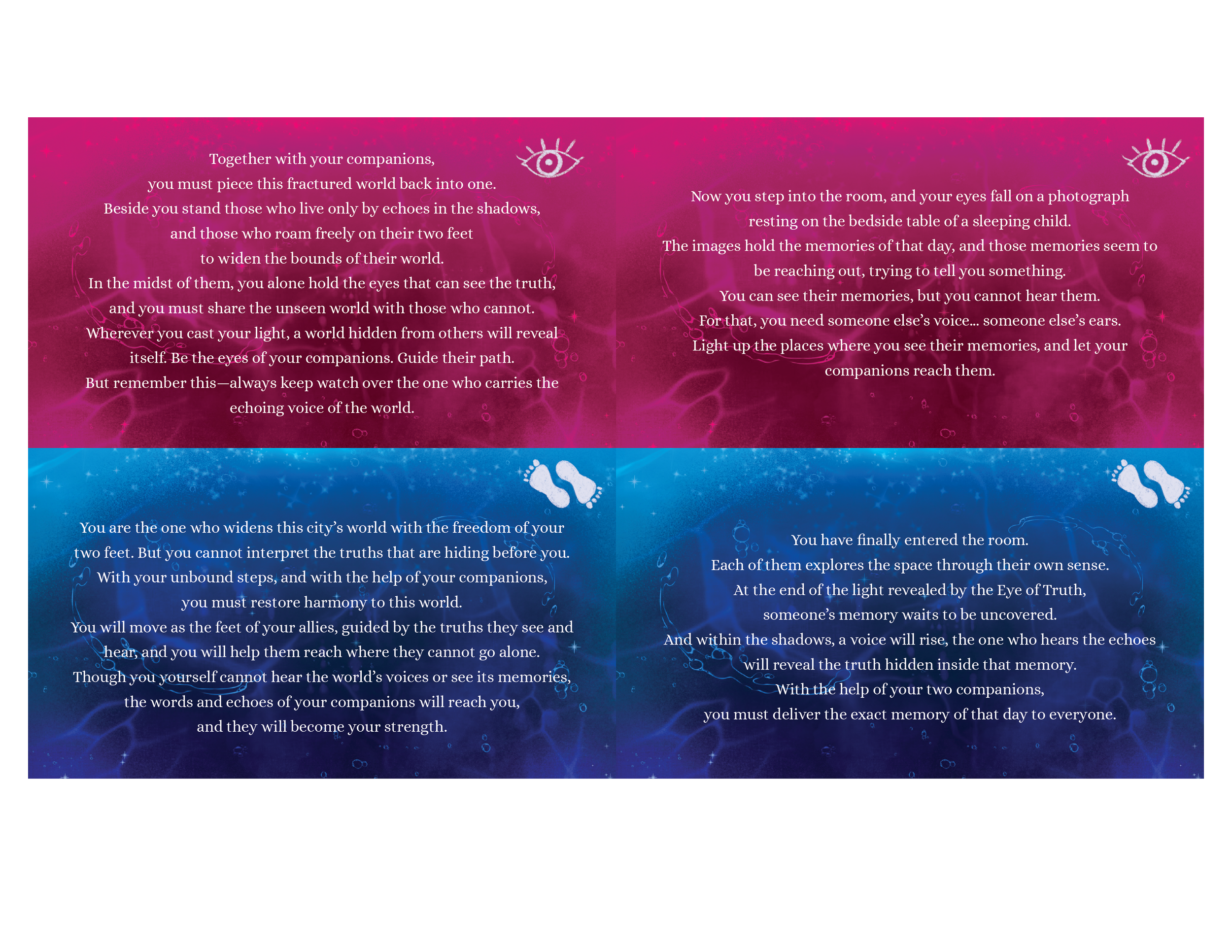
These elements formed the core setup of the prototype. Alongside them, I prepared printed instructions and a short prologue video to establish the narrative tone of the game. I used D12’s classroom as the testing environment and placed all the relevant objects and clues throughout the space for players to discover and interpret collaboratively. I made them enter the room while seeing the map of the outer and inner space of the room, and when they entered the room, the Prism player must guide Foggy player to reach the points where the voice recorders are and Prism will tell what the photos are showing, and Foggy will take Shaded player to each spot and Shaded will hear the recordings in each one of them and they all collaboratively find the correct recording that aligns with the 3 photos. I came up with this task as an exercise in verifying information together, not just trusting one of the senses; each sense also represents the limitations of information that we can gain. When we are sharing information with others, we should make sure that the information we have is fully verified and true. Also, there might be some background information and stories that we don’t know.
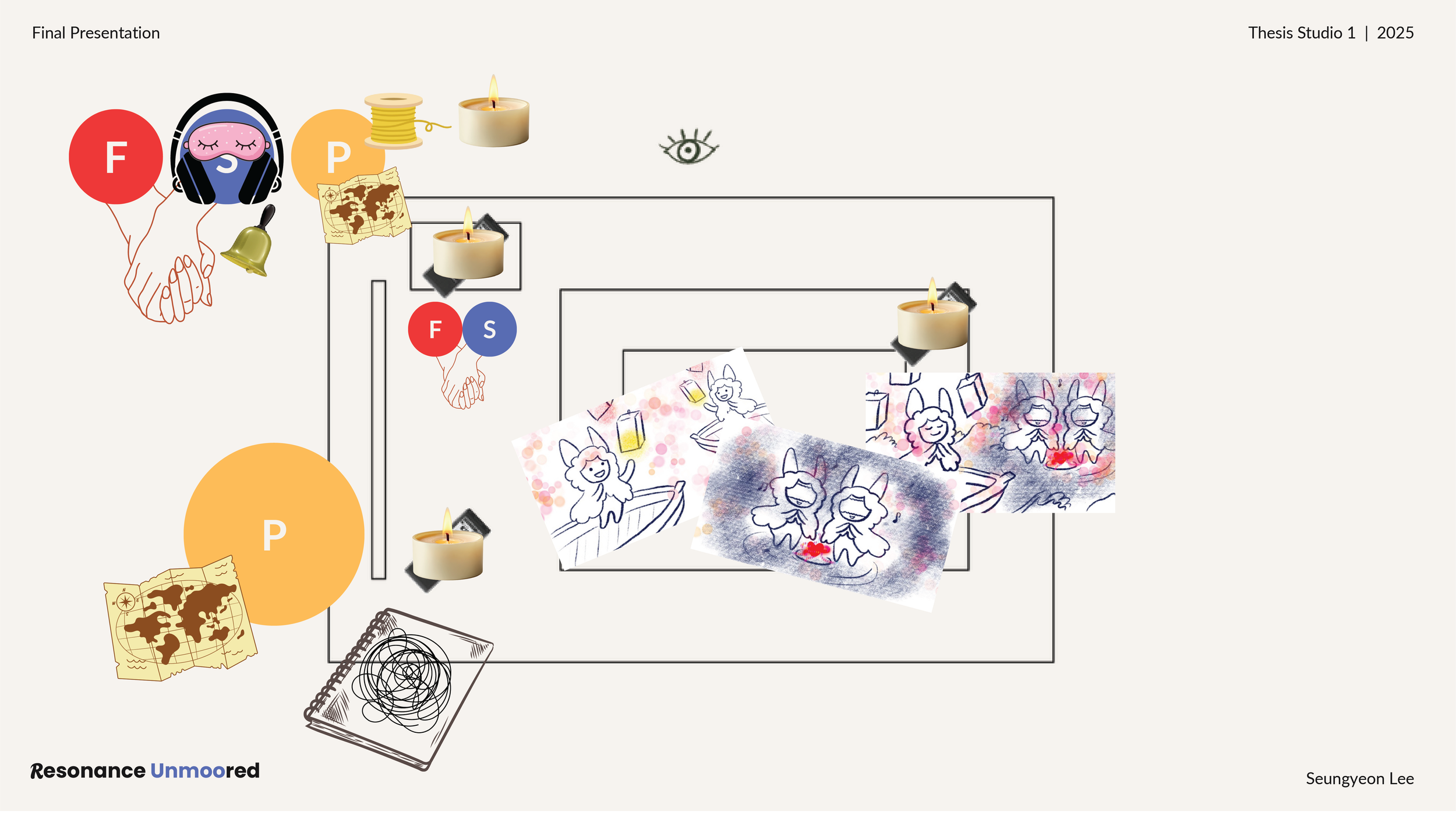
Below are the objects and instructions I prepared for this version of the prototype, with the photos taken during the playtesting.
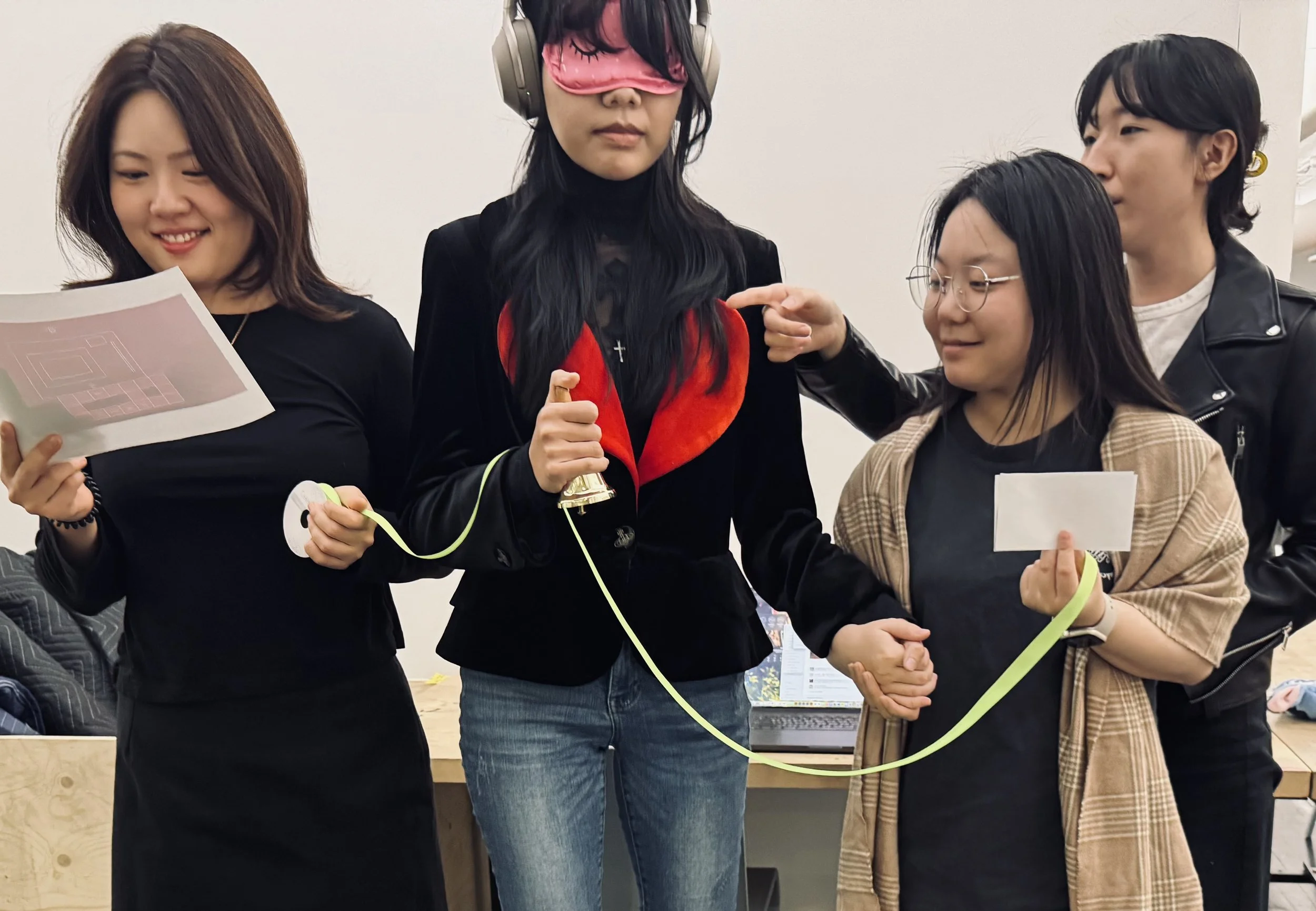
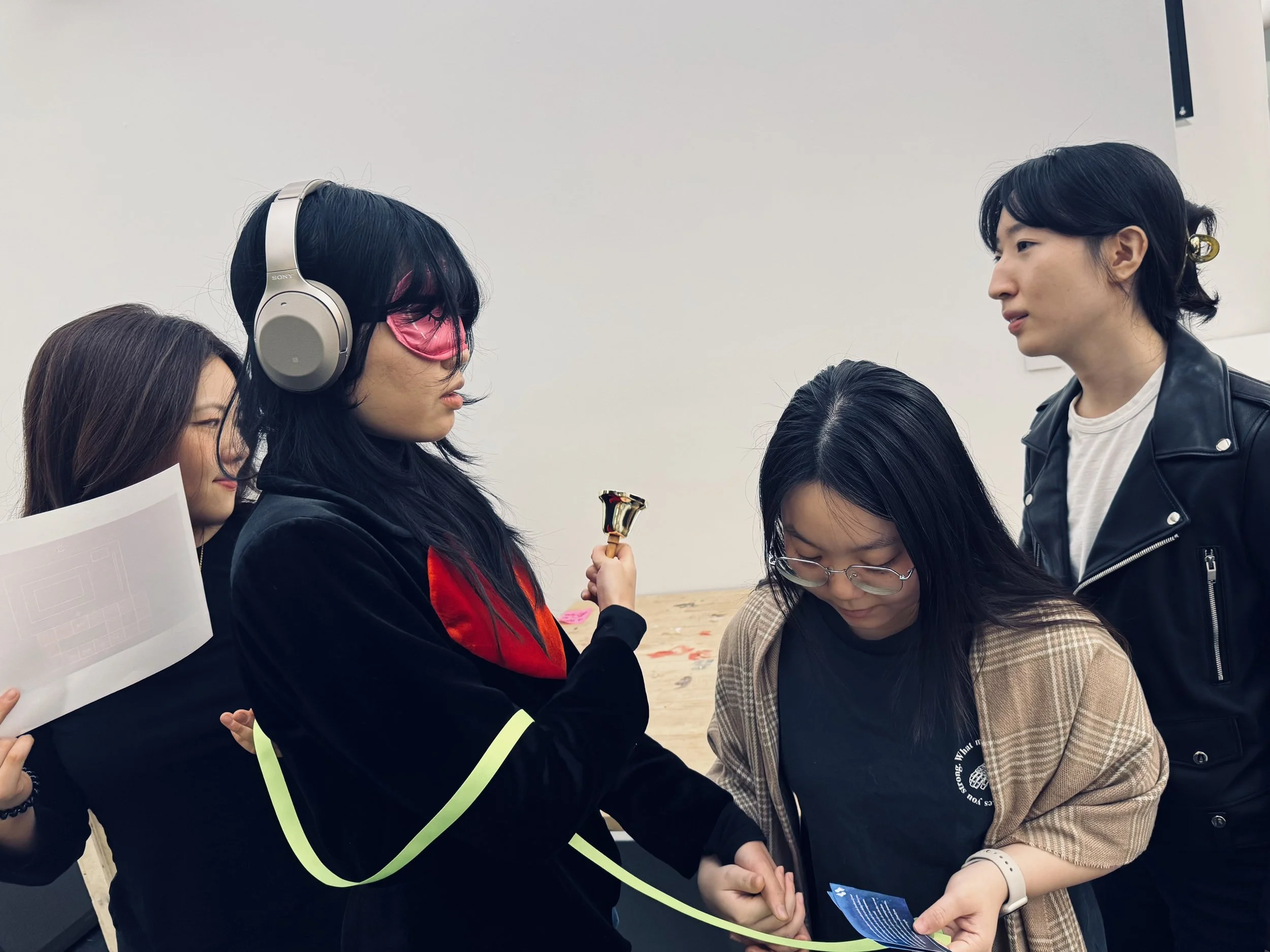
Game Loop Playback
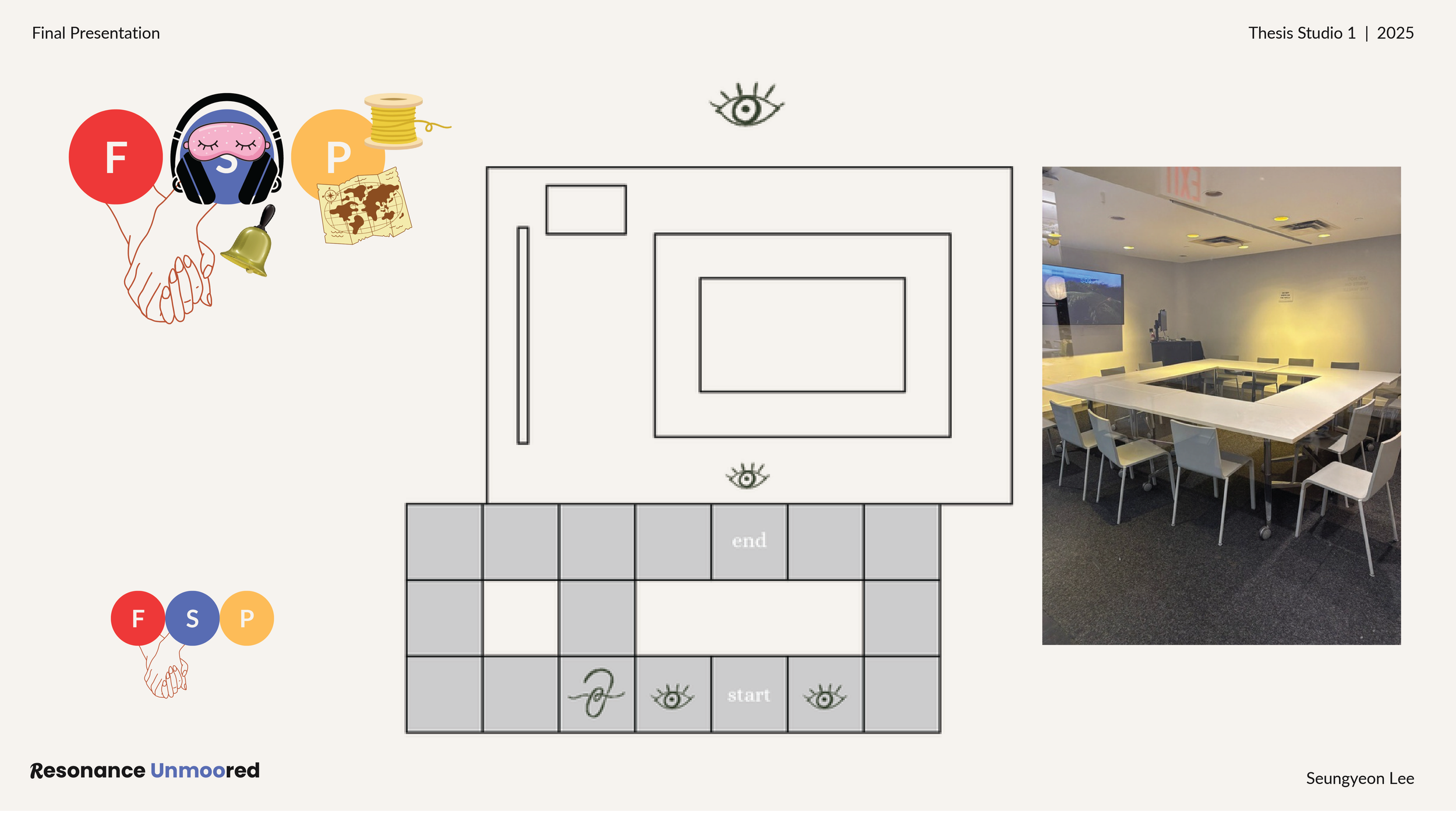
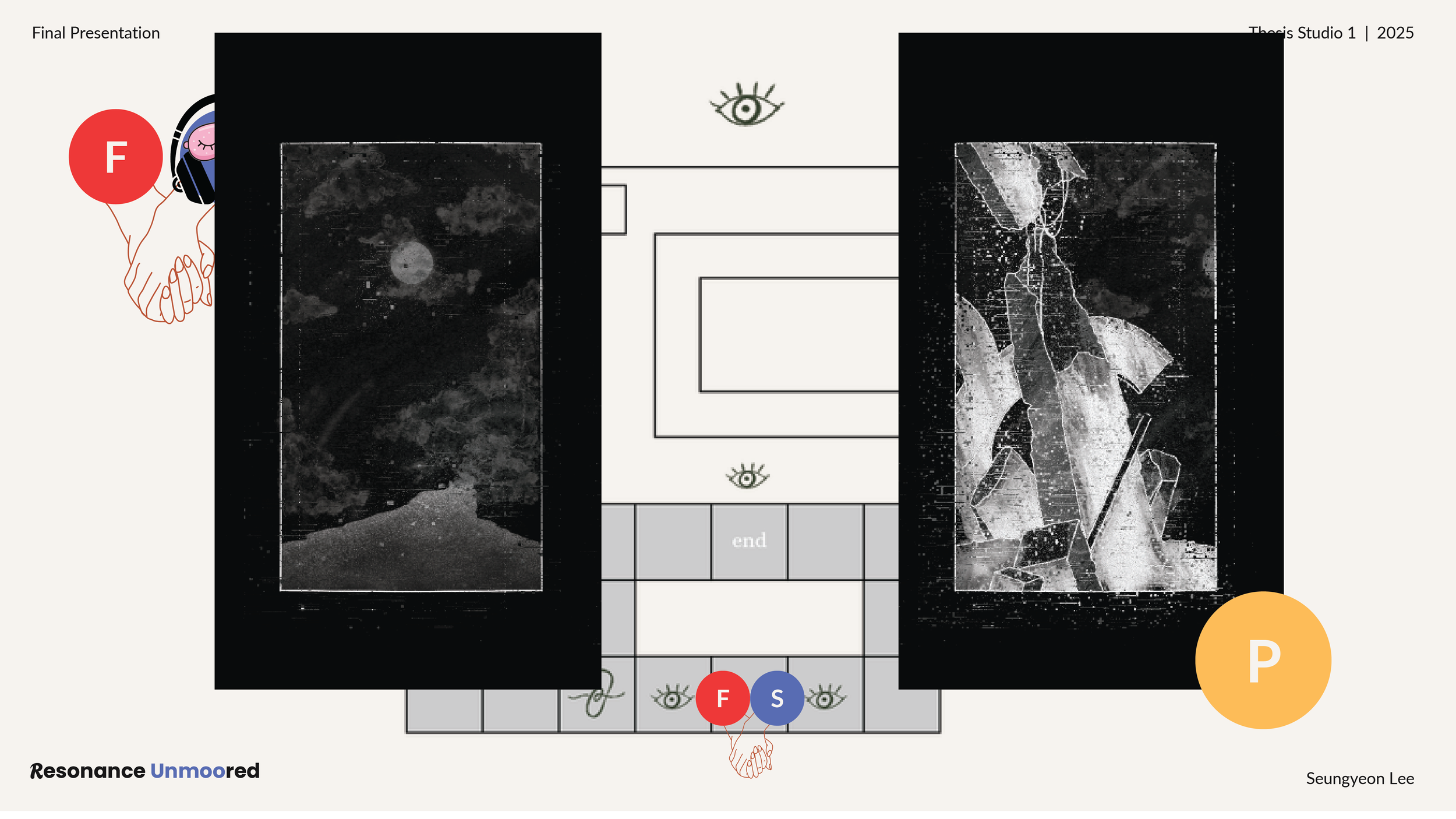
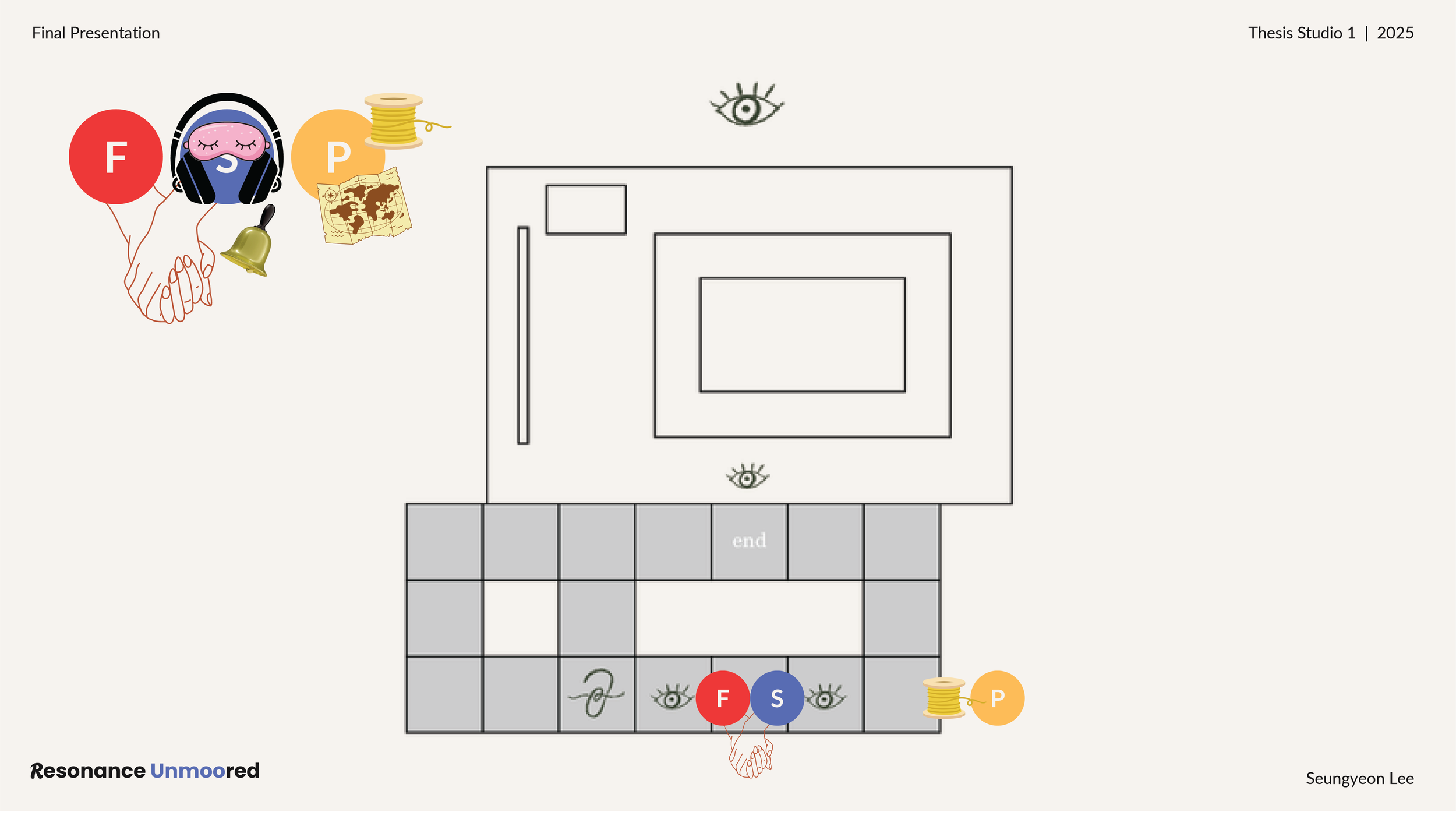
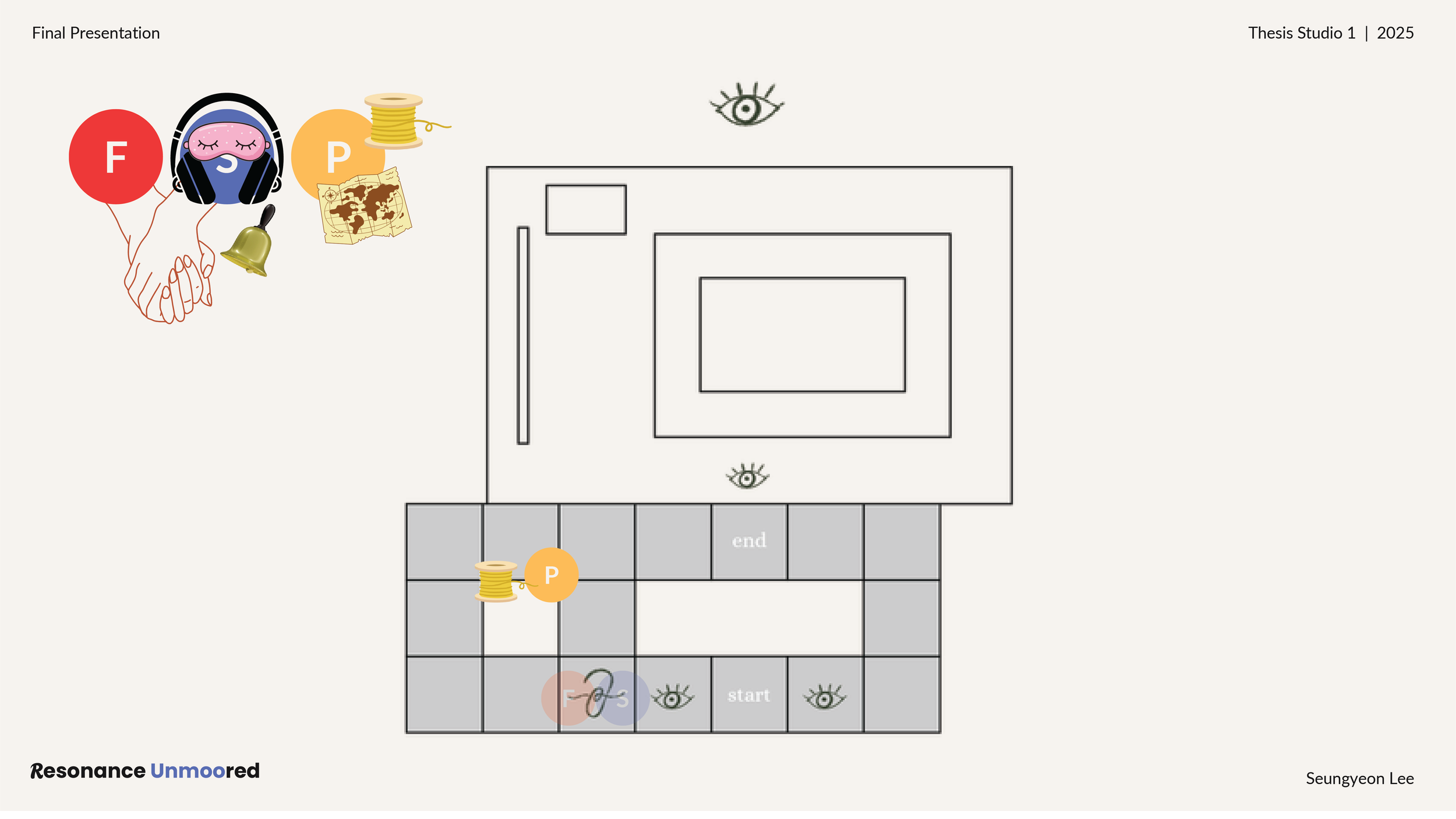
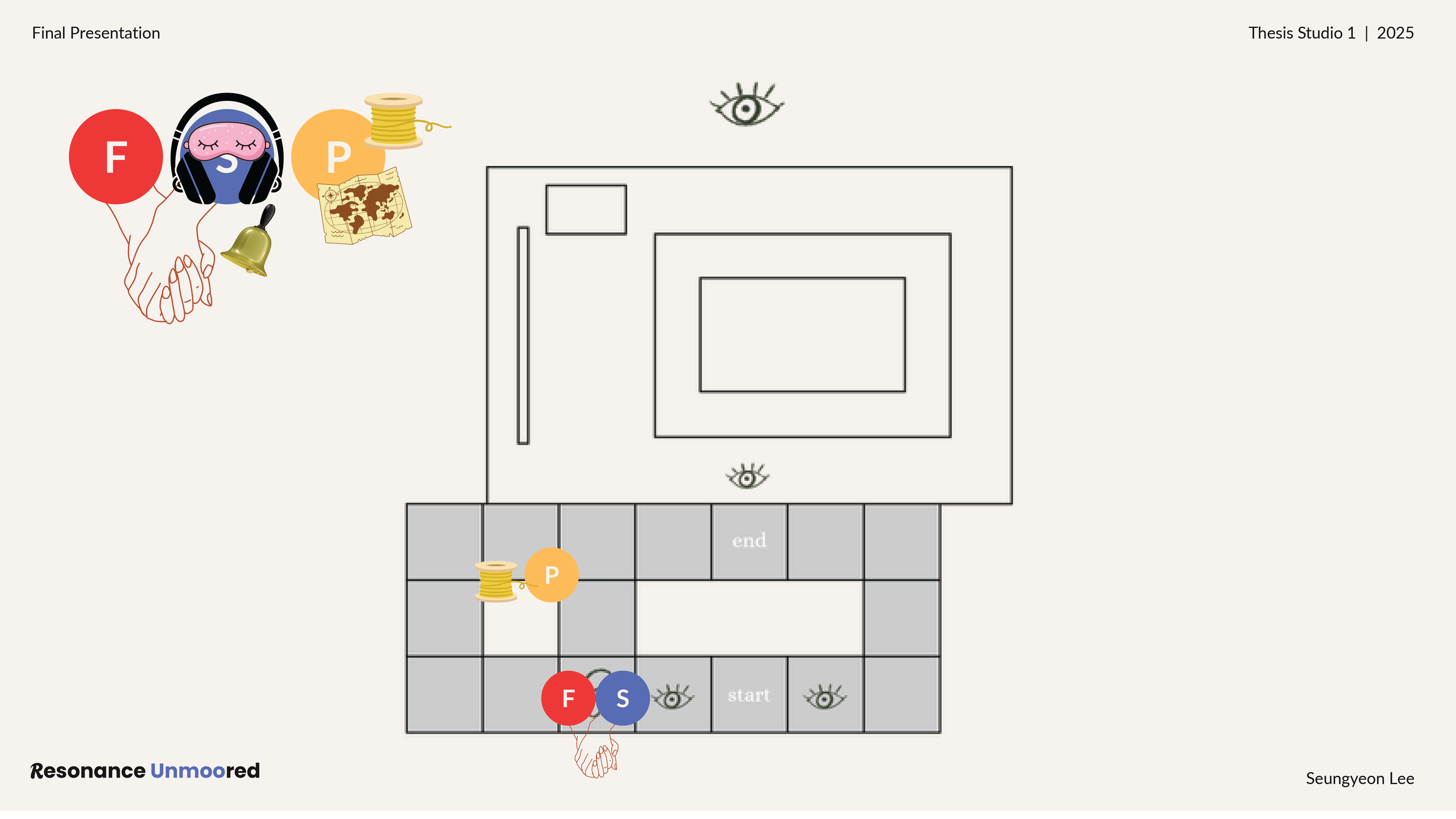
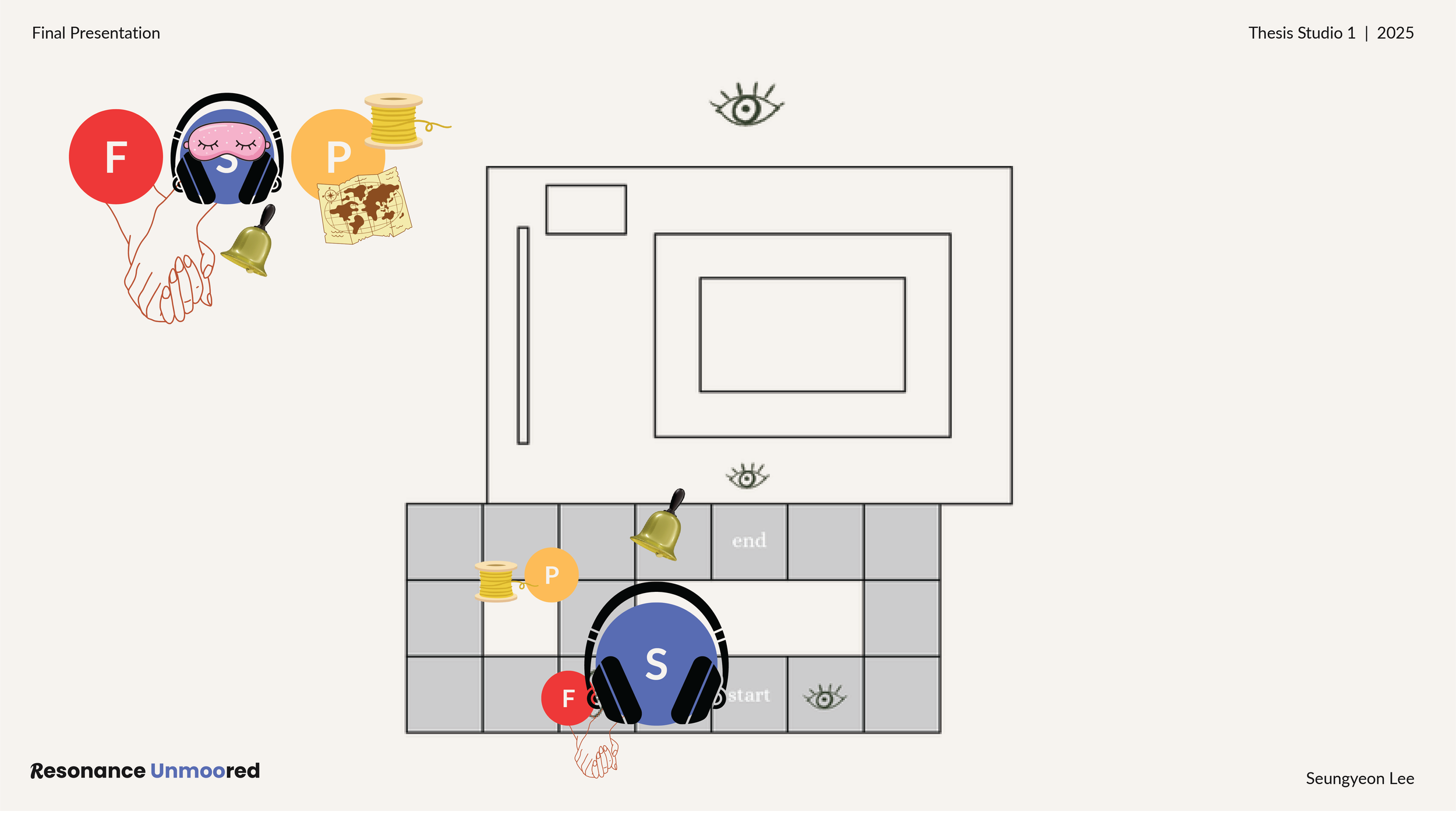
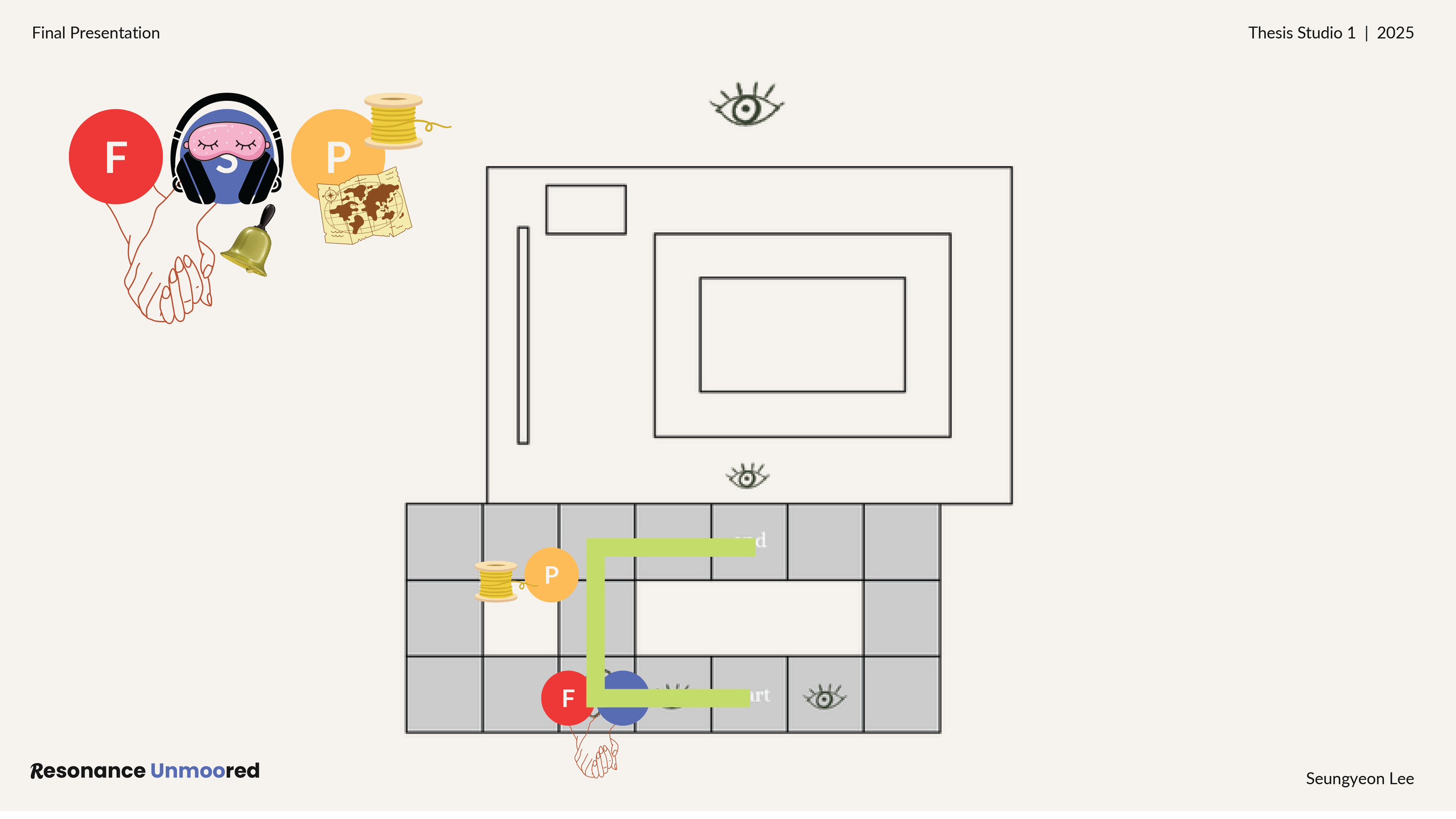
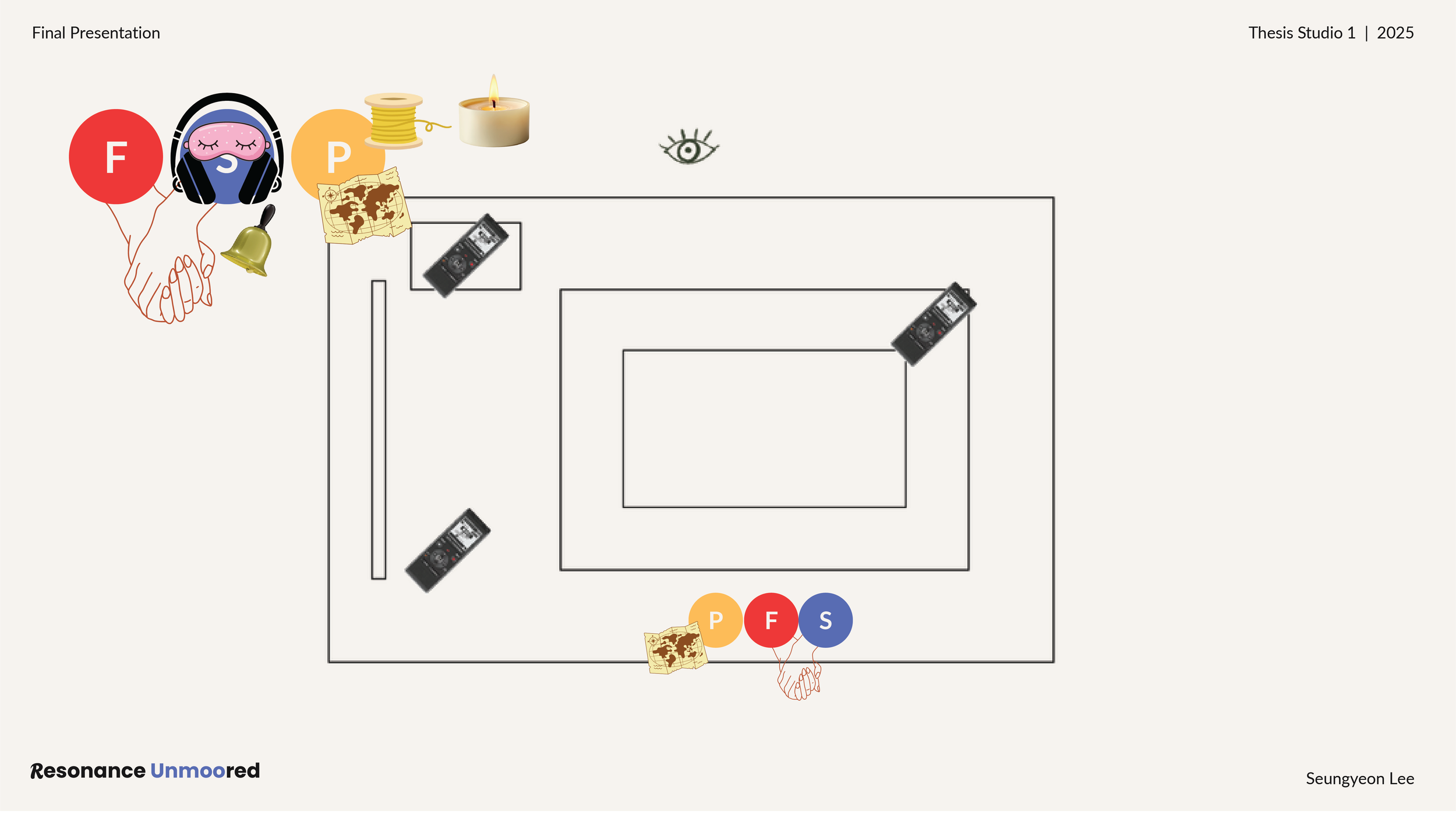
The prototype begins with three representatives, Foggy, Prism, and Shaded, standing at the entrance to the play space. For the prototype, I used classroom 1202 in D12 and constructed a simplified map based on the room’s real furniture layout. All players start together at the designated starting point before entering the room.
Role of Each Player
Prism Player: Visual Knowledge Holder
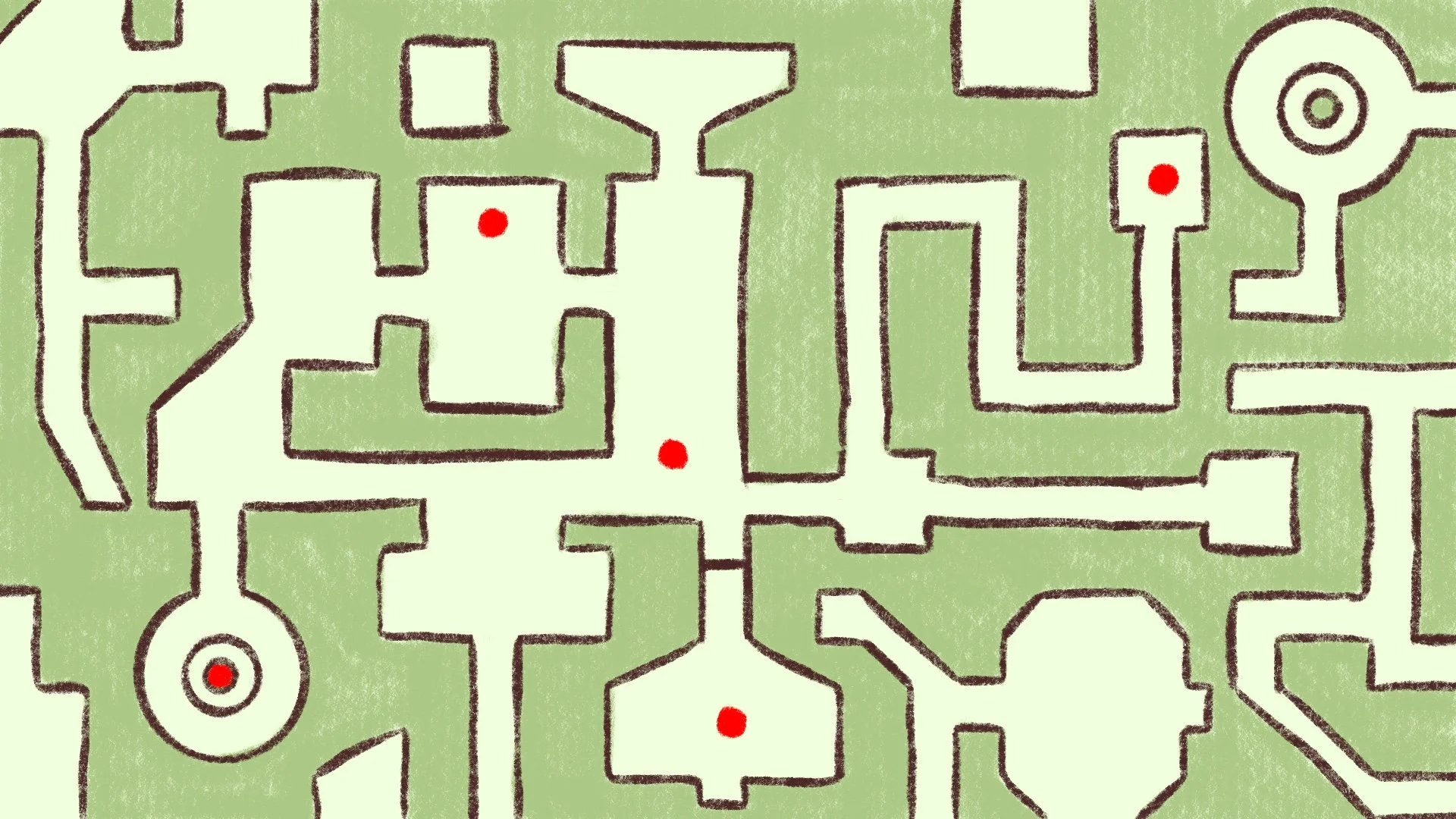
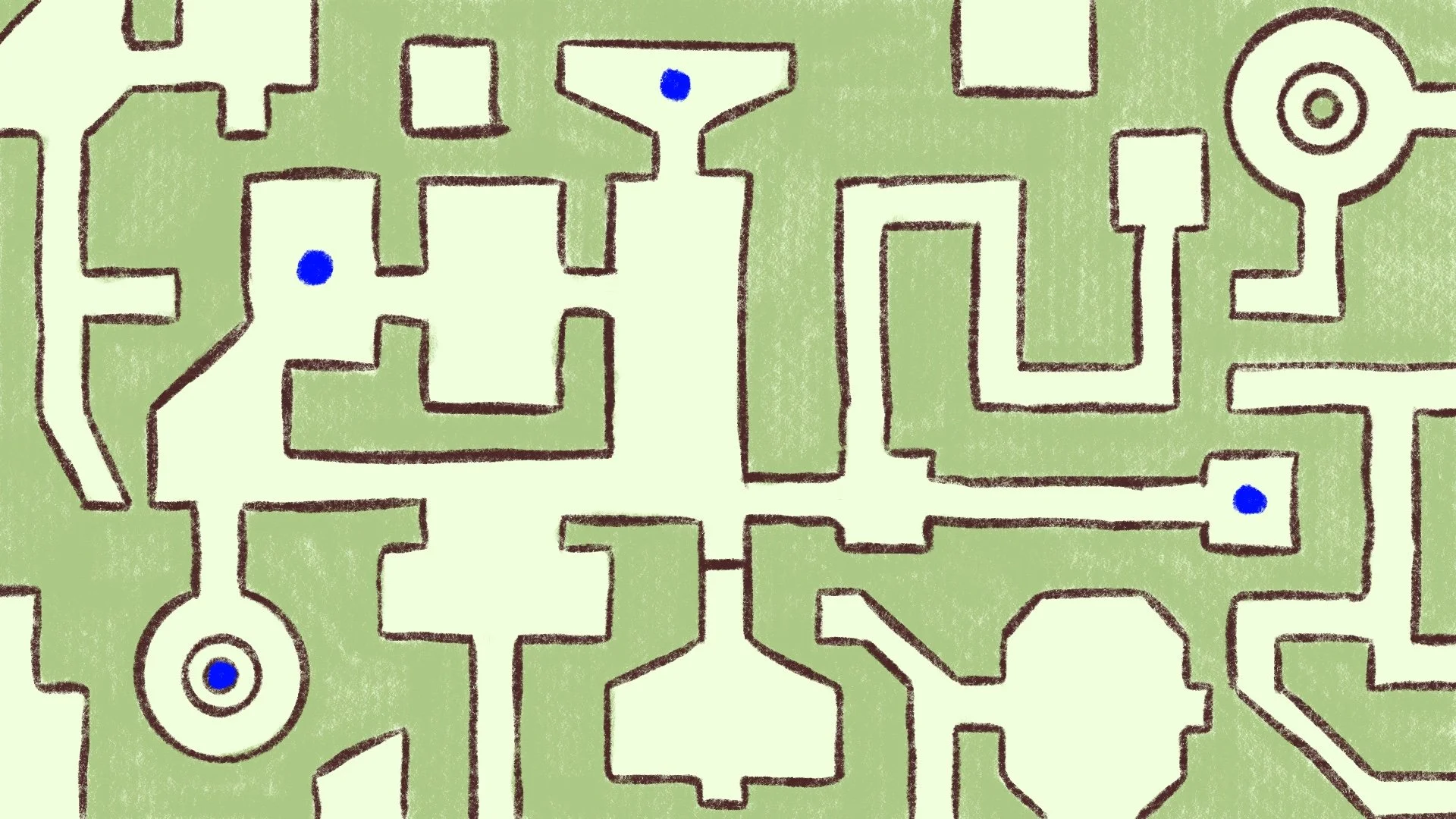
The Prism player begins with a map showing the walkable tiles(rendered in gray) and the locations of both visual and sonic clues with eye and ear icons on the map.
● Eye icons mark where visual clues become accessible only when Foggy physically steps onto that tile.
● Ear icons mark locations where auditory resonance can be triggered by Shaded.
The Prism player also carries a long neon ribbon. Their role is to physically draw paths that guide the team, marking safe passages and signaling where the group should move next. Since Foggy cannot perceive cues themselves, Prism becomes their primary visual interpreter.
Shaded Player: Sonic Navigator
The Shaded player begins the game blindfolded with the sleep mask to restrict vision and wears headphones to receive spatialized audio cues triggered at specific locations. They also carry a wooden handle liberty bell, used to ping the environment.
By ringing the bell in different directions, Shaded can detect acoustic differences, subtle echoes, obstructions, or resonant clues based on the design of the puzzle.
Shaded’s task is to interpret the space through sound and communicate what they perceive to Foggy, who then translates it for Prism.
Foggy Player: Movement and Meditation
The Foggy player is the only player who can move freely in space and can use all senses to communicate, guiding Shaded physically by hand. Foggy becomes the translator between Shaded’s sonic descriptions and Prism’s visual language, bridging the two sensory worlds.
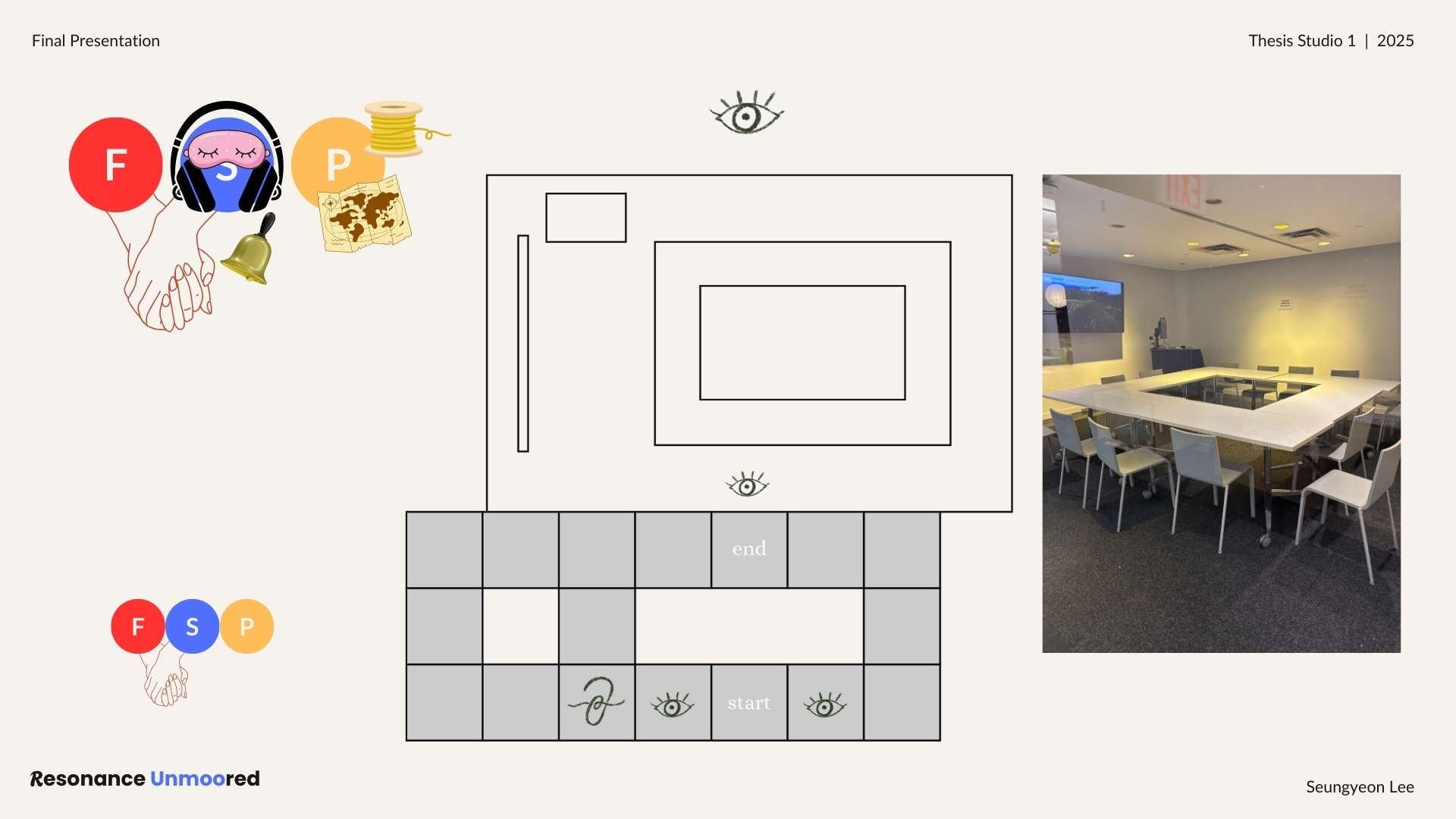
Phase I: Navigating the 9 x 3 Tile Map
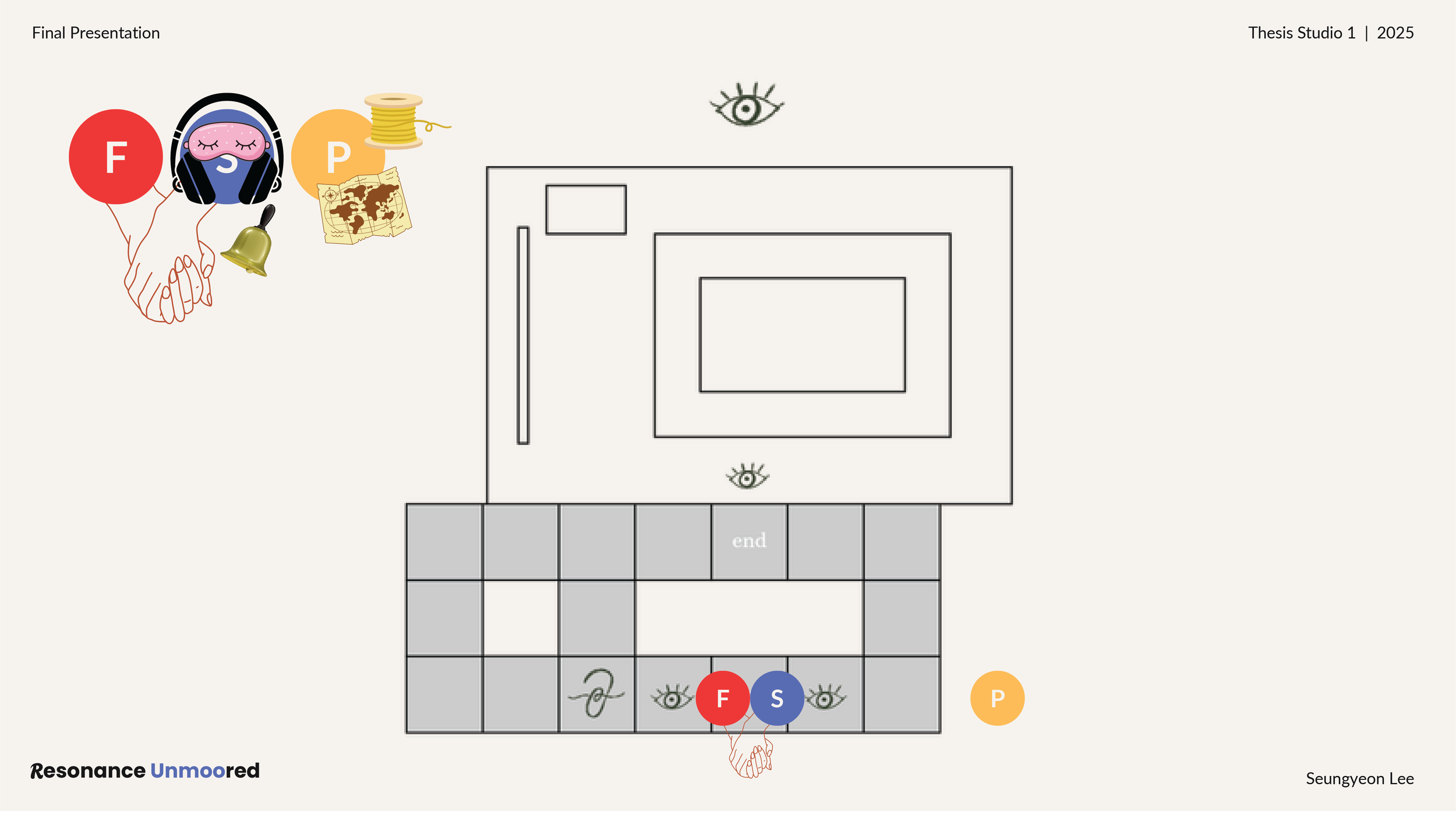
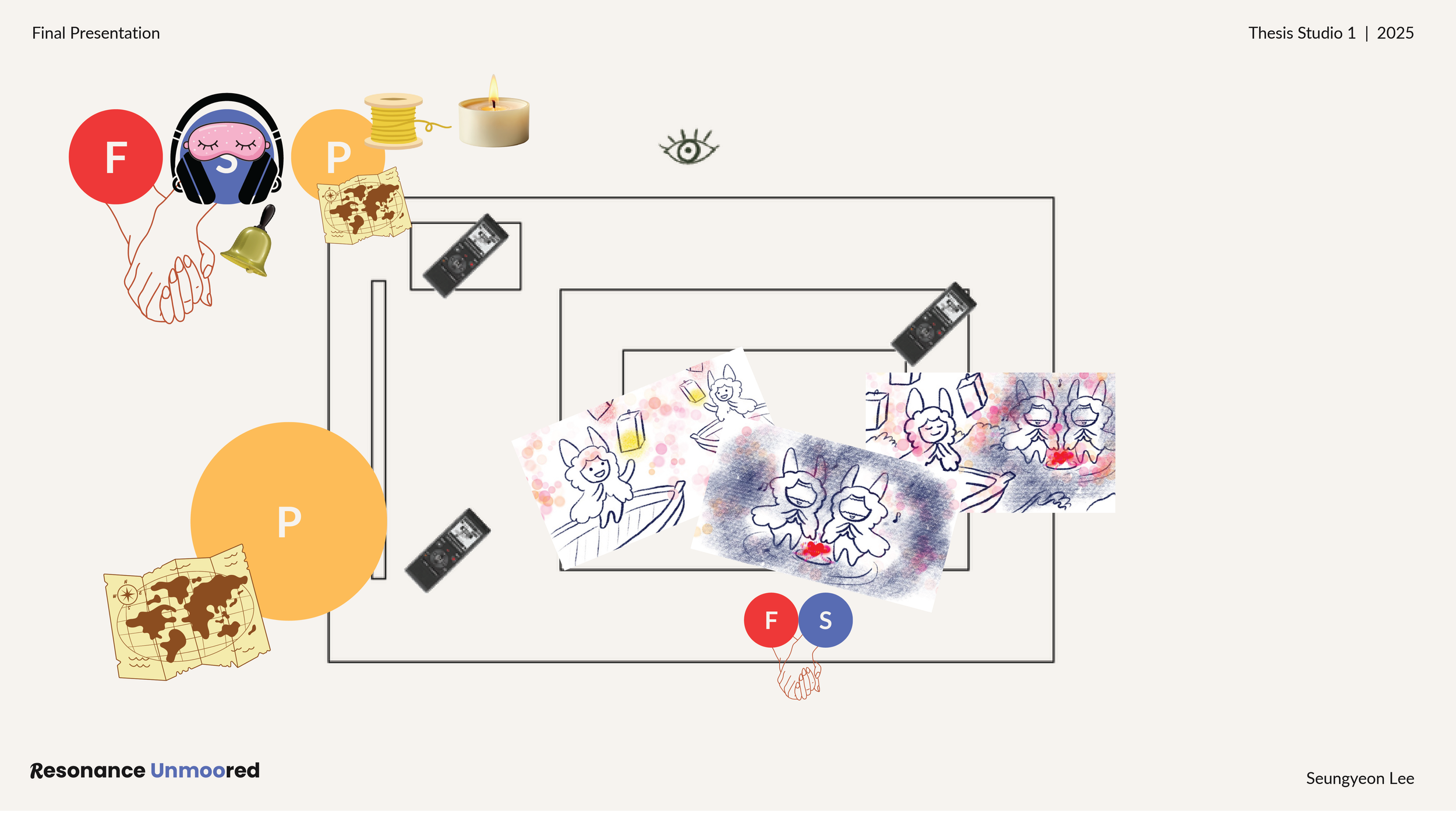
The initial grid consists of 9 rows by 3 columns of tiles. The tiles with a gray color that indicate the grid where players are able to step on are only visible to the Prism player. Others will only see the full 9 x 3 tile map grid without colors. At the starting point, two eye icons, left and right, immediately activate Prism’s visual clues.
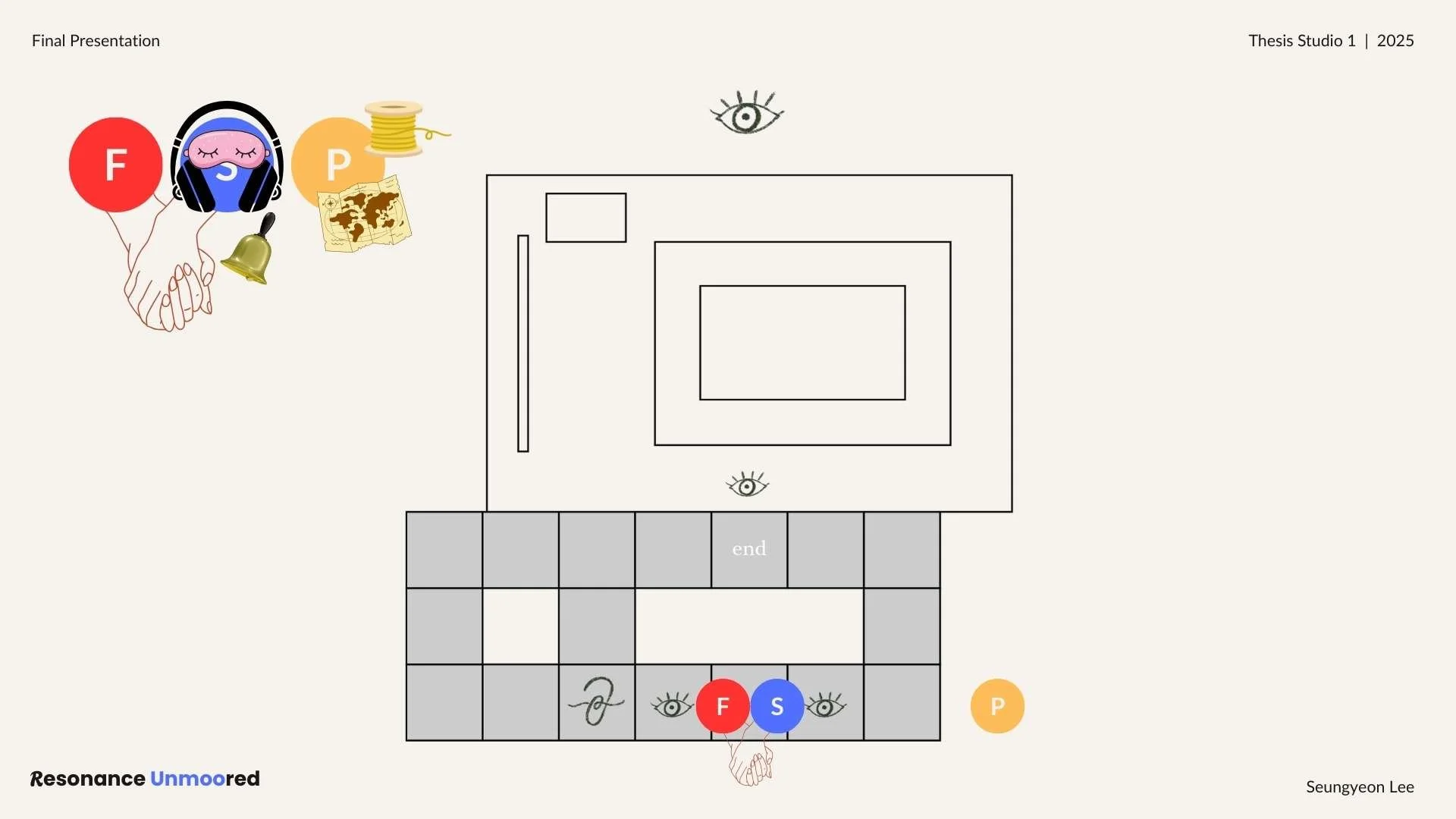
At the starting point, Prism will guide other players with the tile map with visual clues in it, and Foggy and Shaded players will hold their hands together throughout the gameplay.
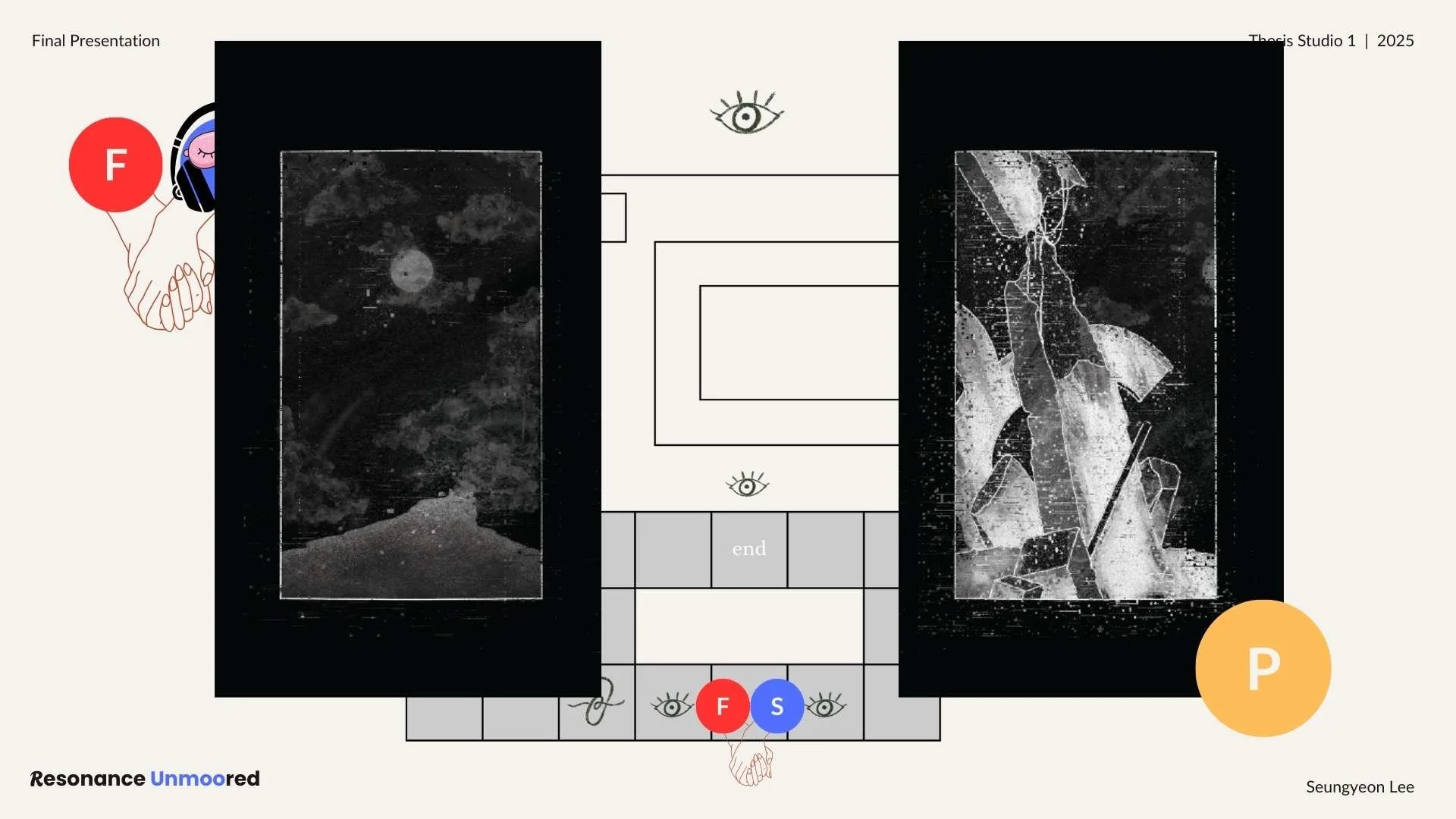
Prism evaluates both directions:
● Right side: collapsing structures, visually unsafe.
● Left side: an open pathway covered with fog.
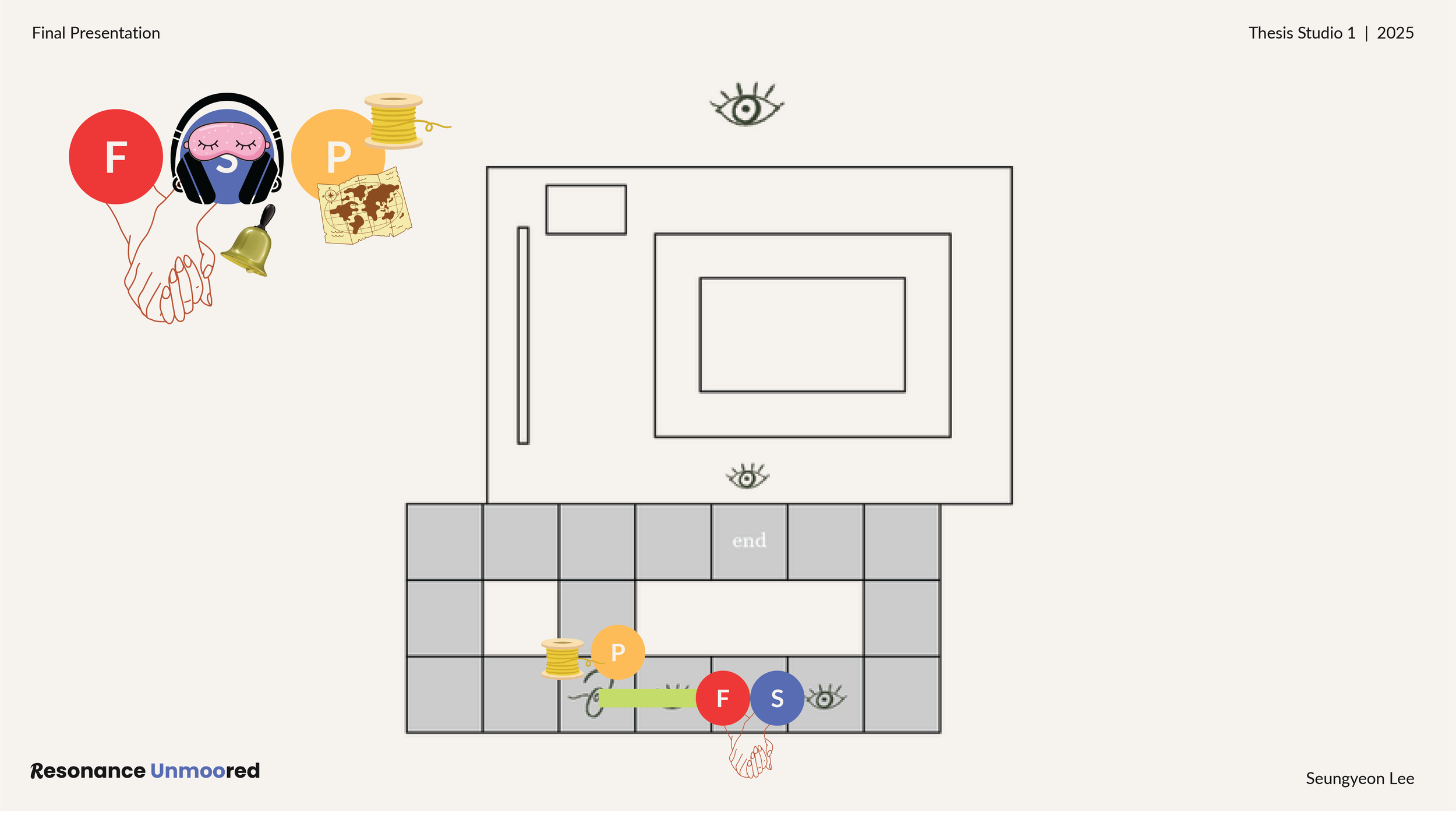
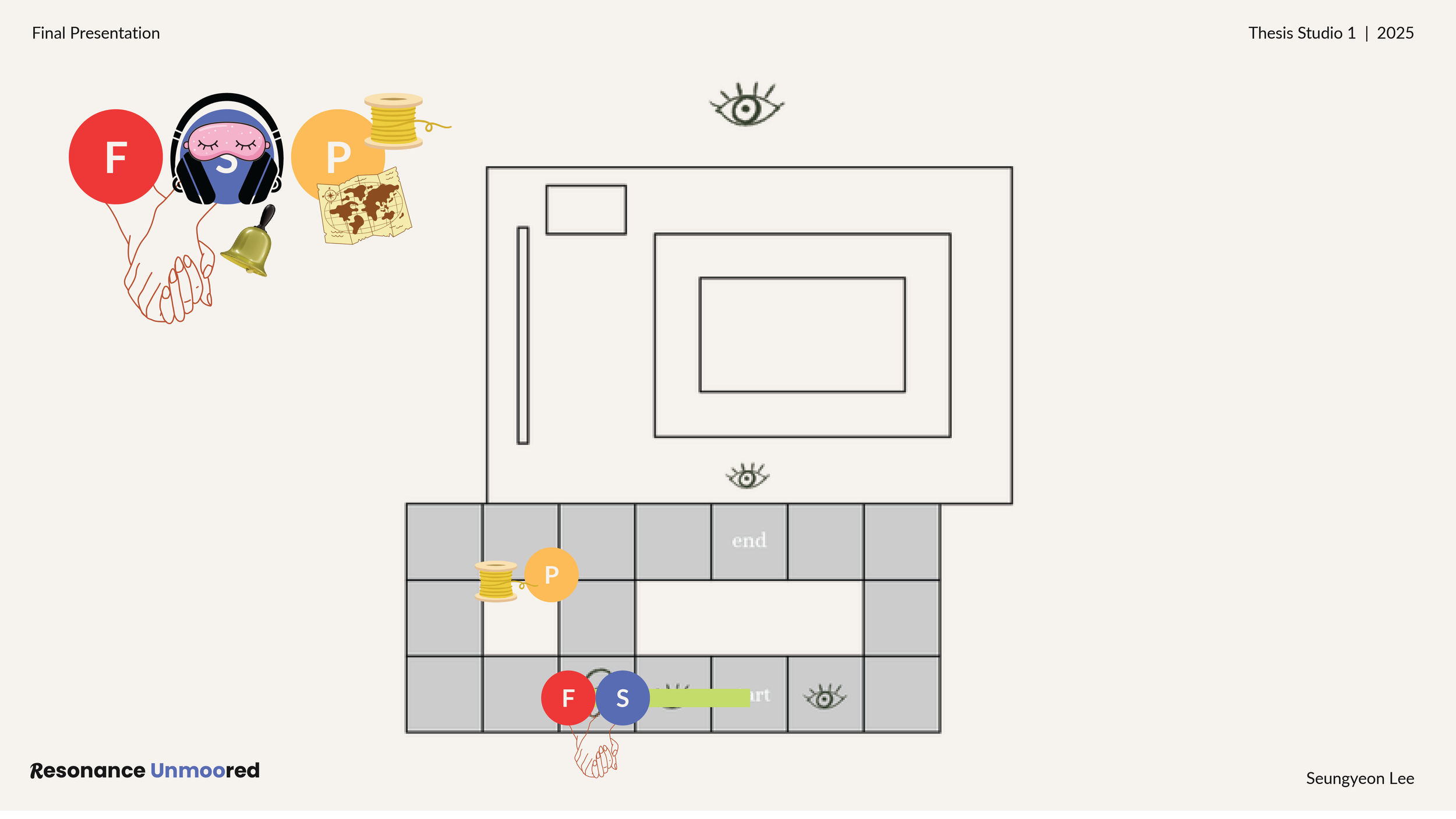
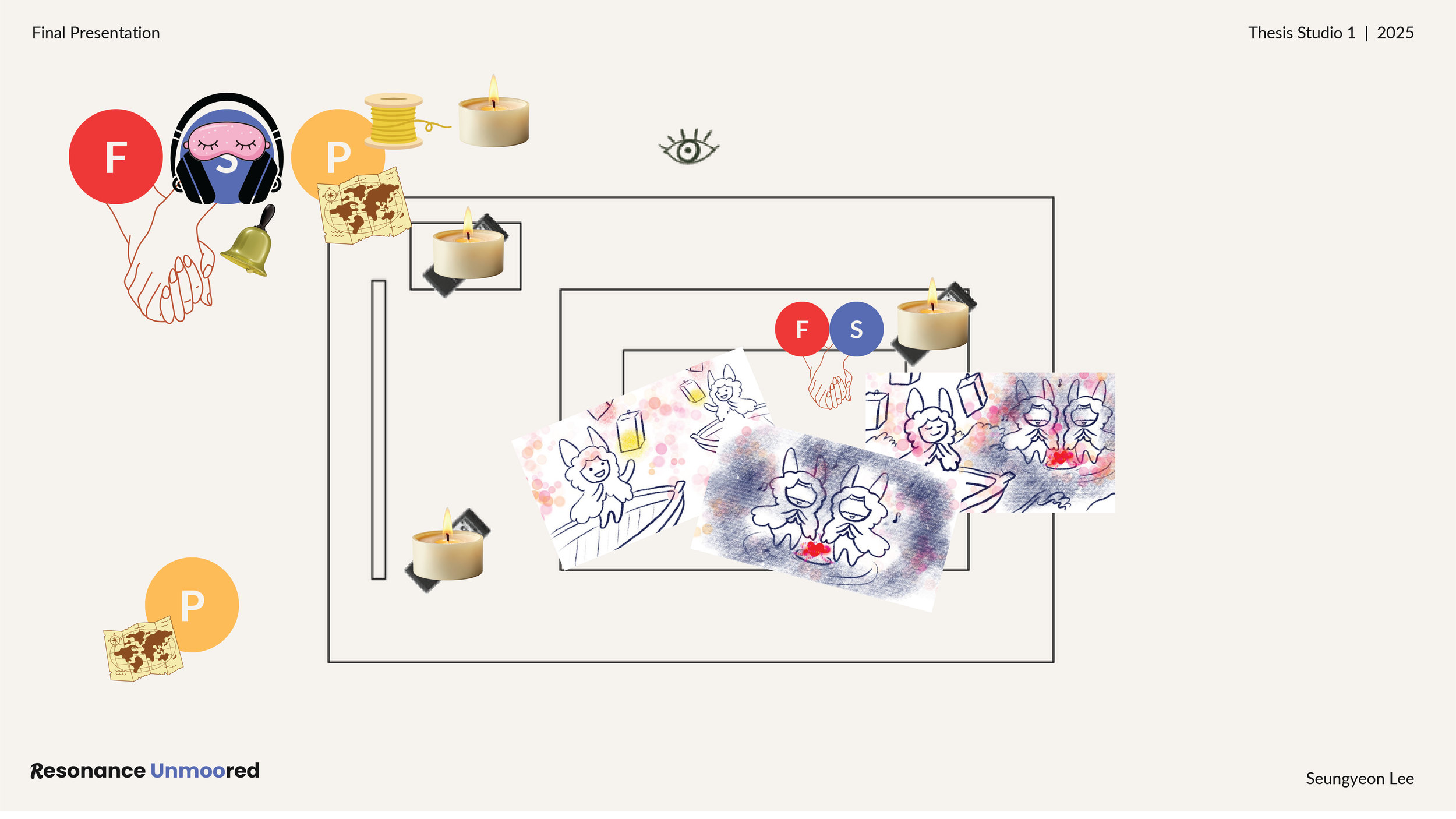
Based on these visual assessments, Prism marks a safe route using the neon ribbon. Foggy and Shaded then follow this marked path together.
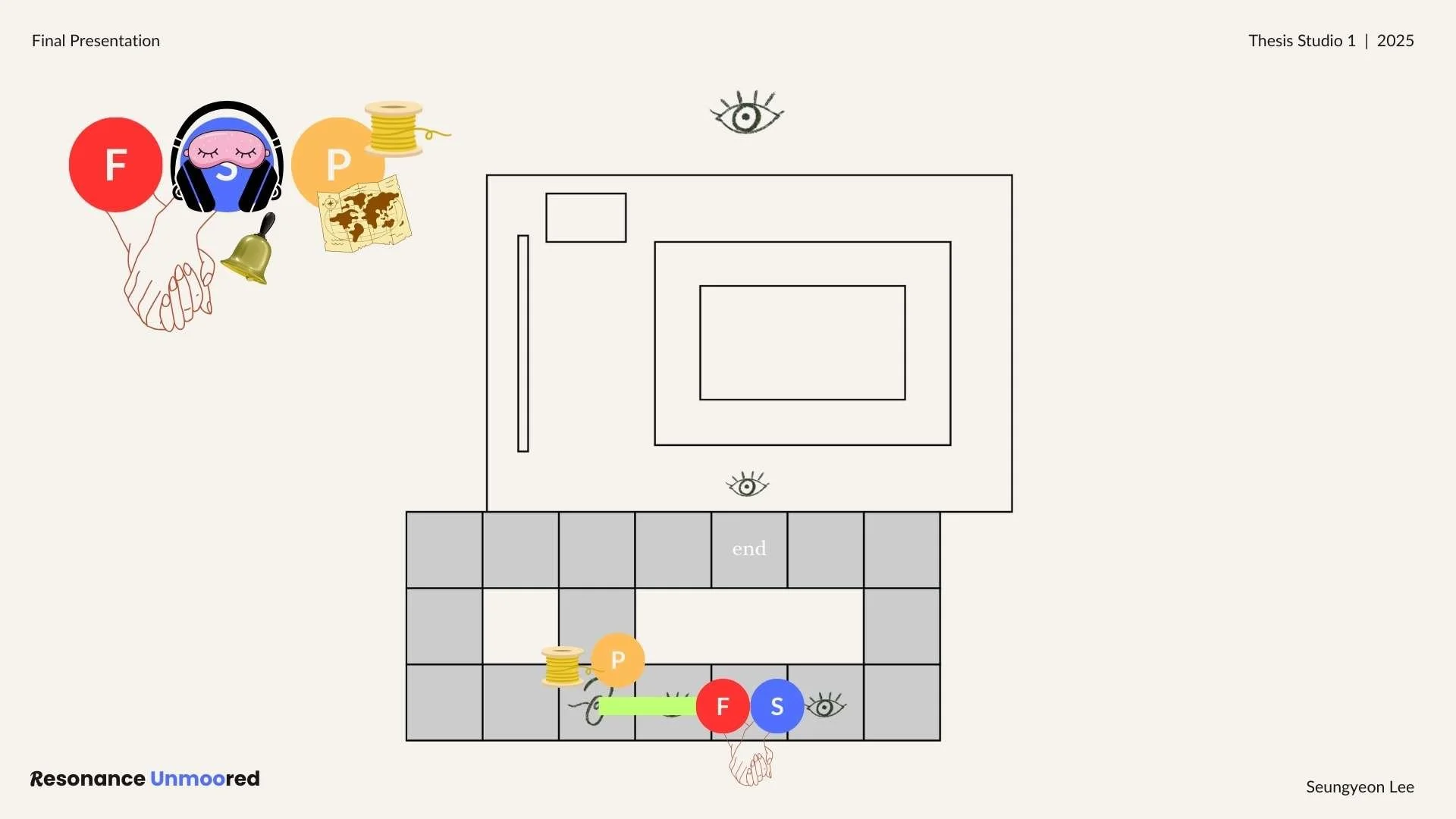
(The neon green line above is the path that the Prism player drew with the ribbon.)
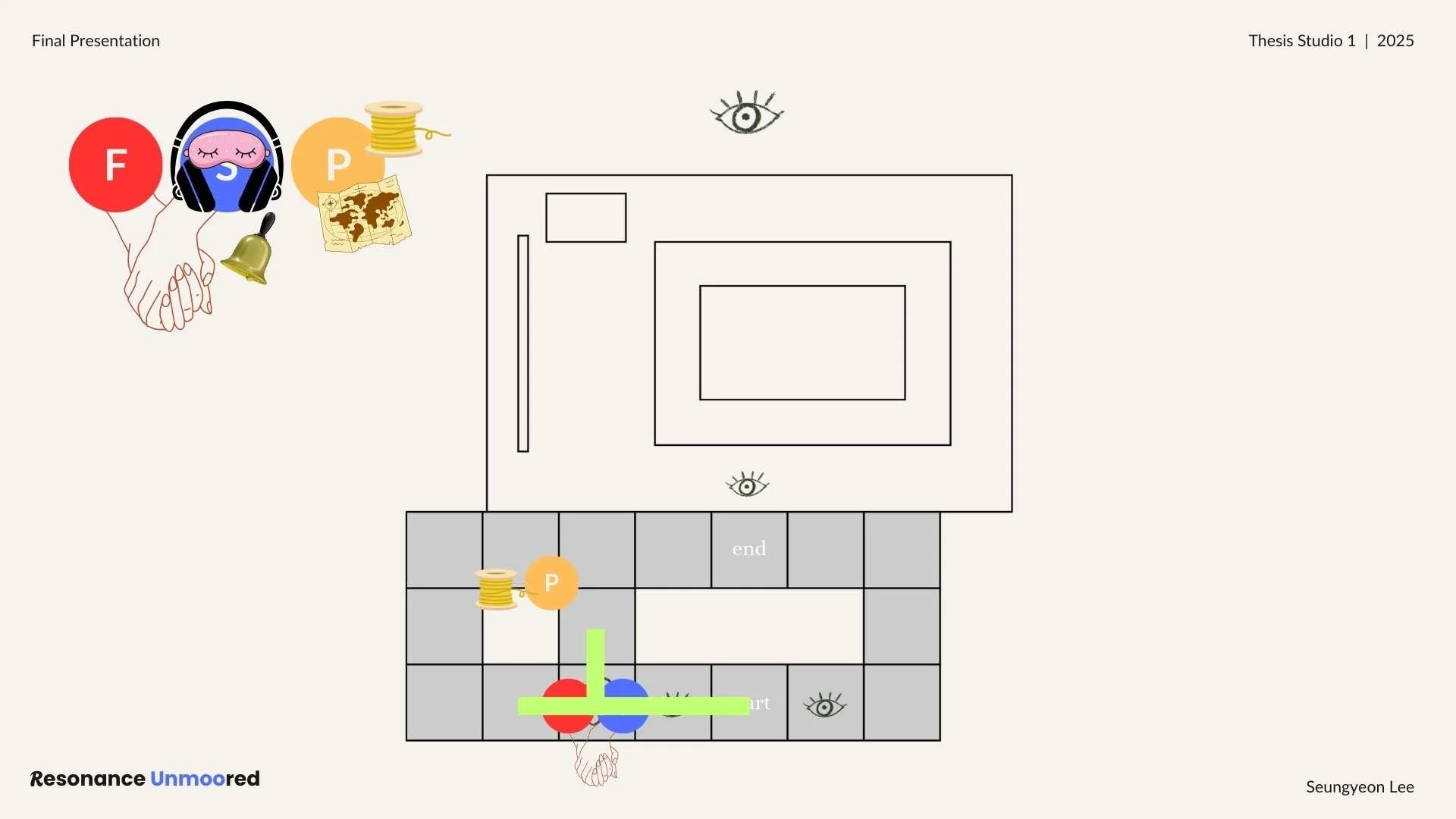
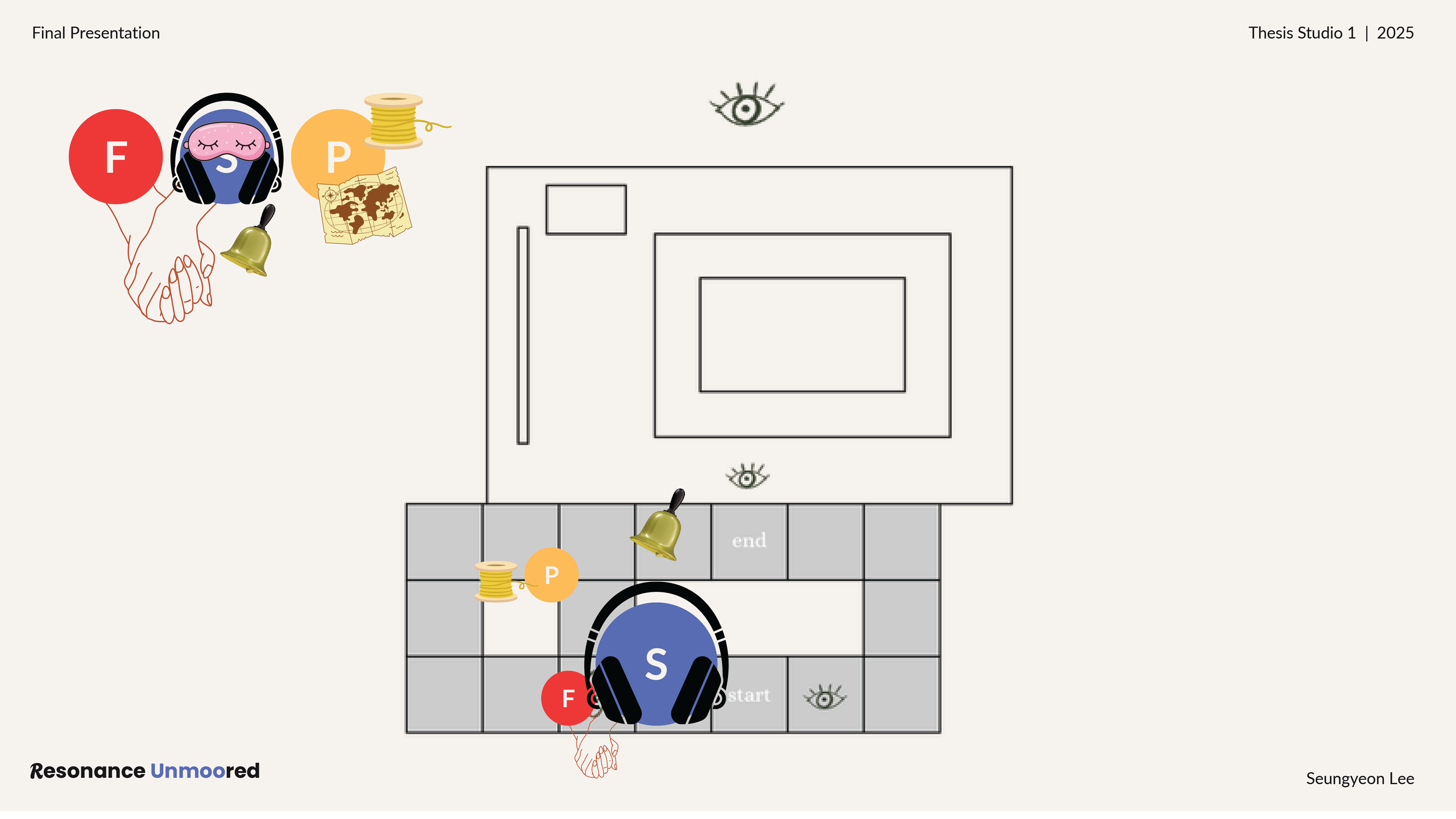
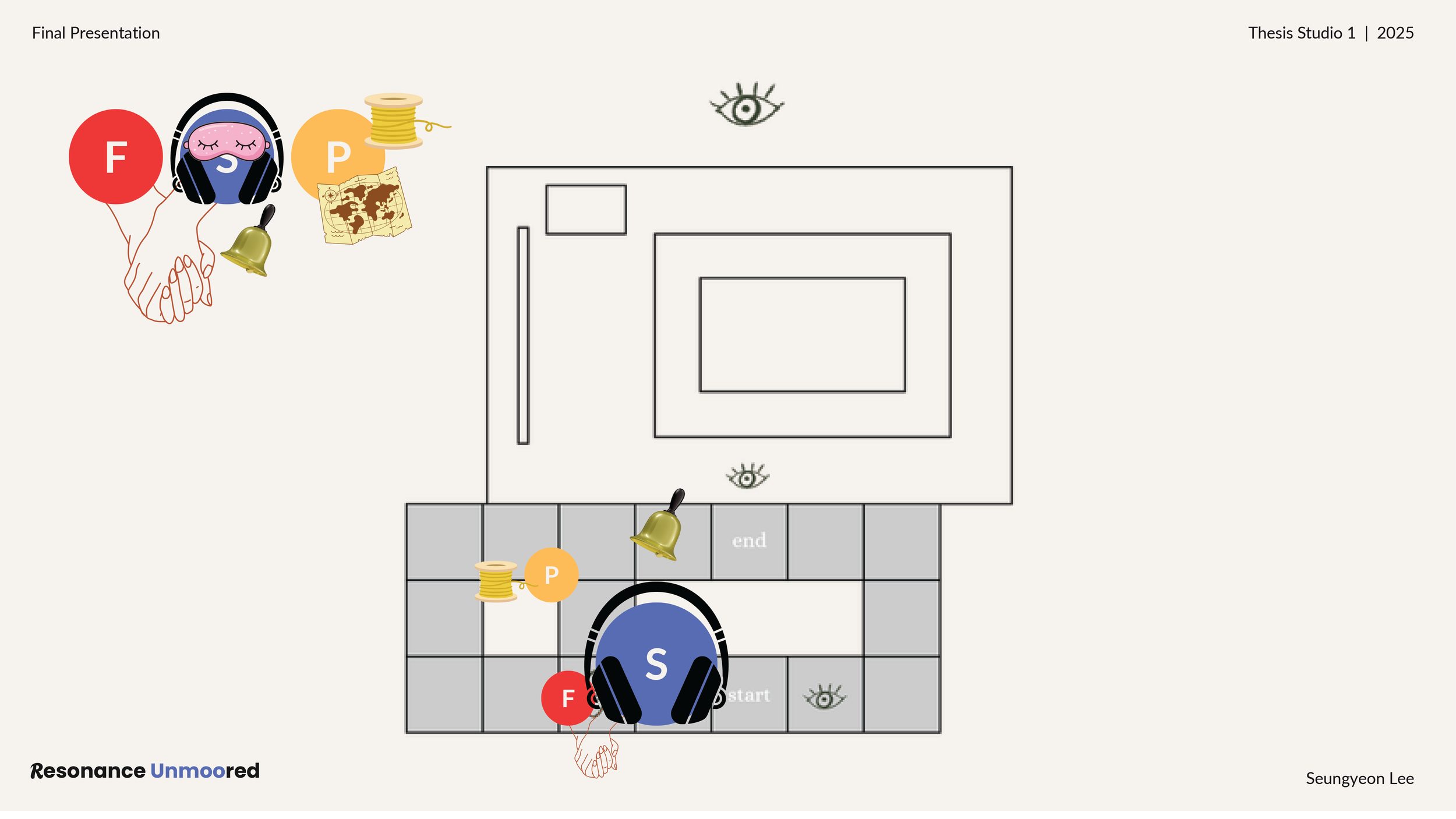
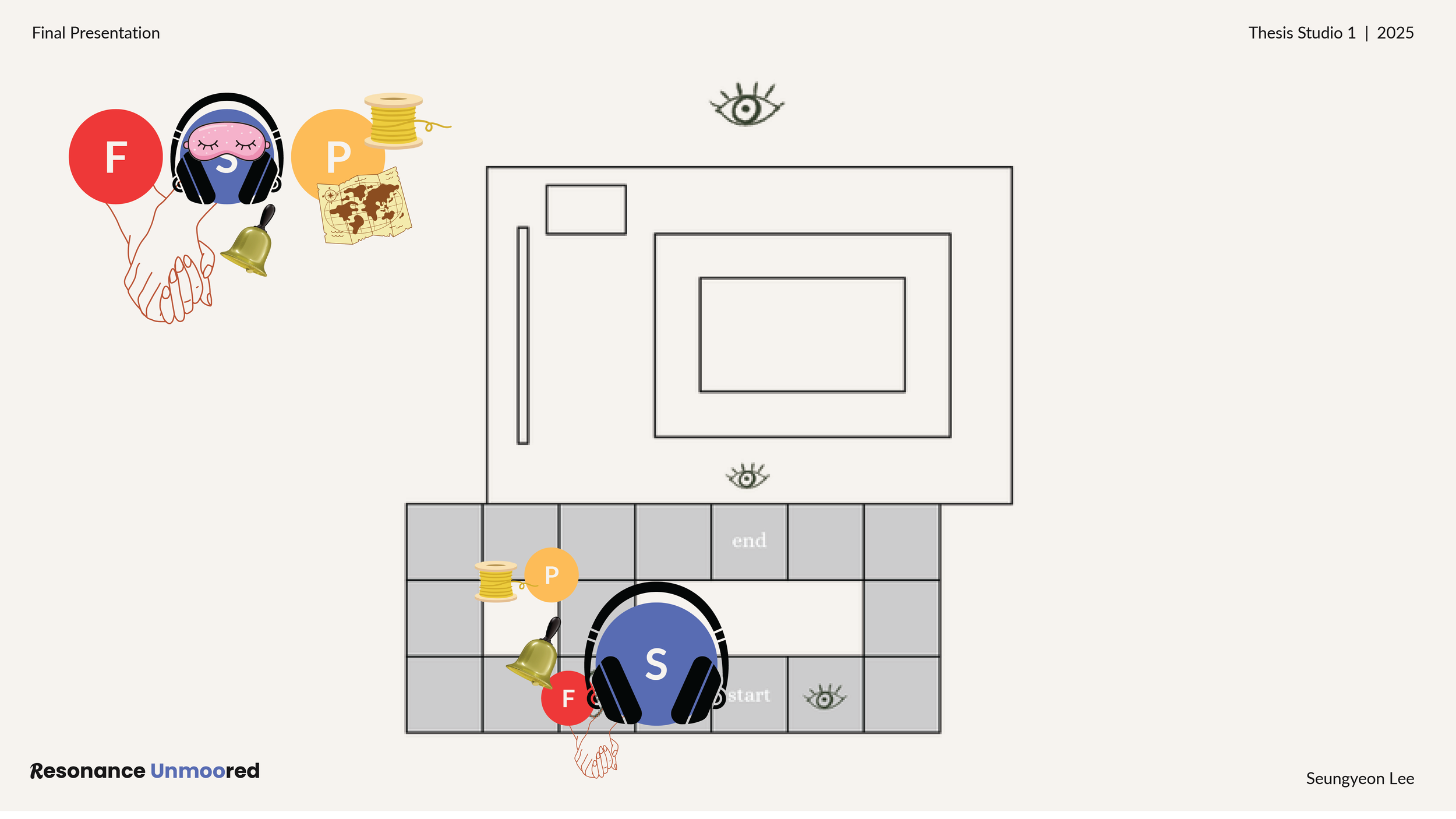
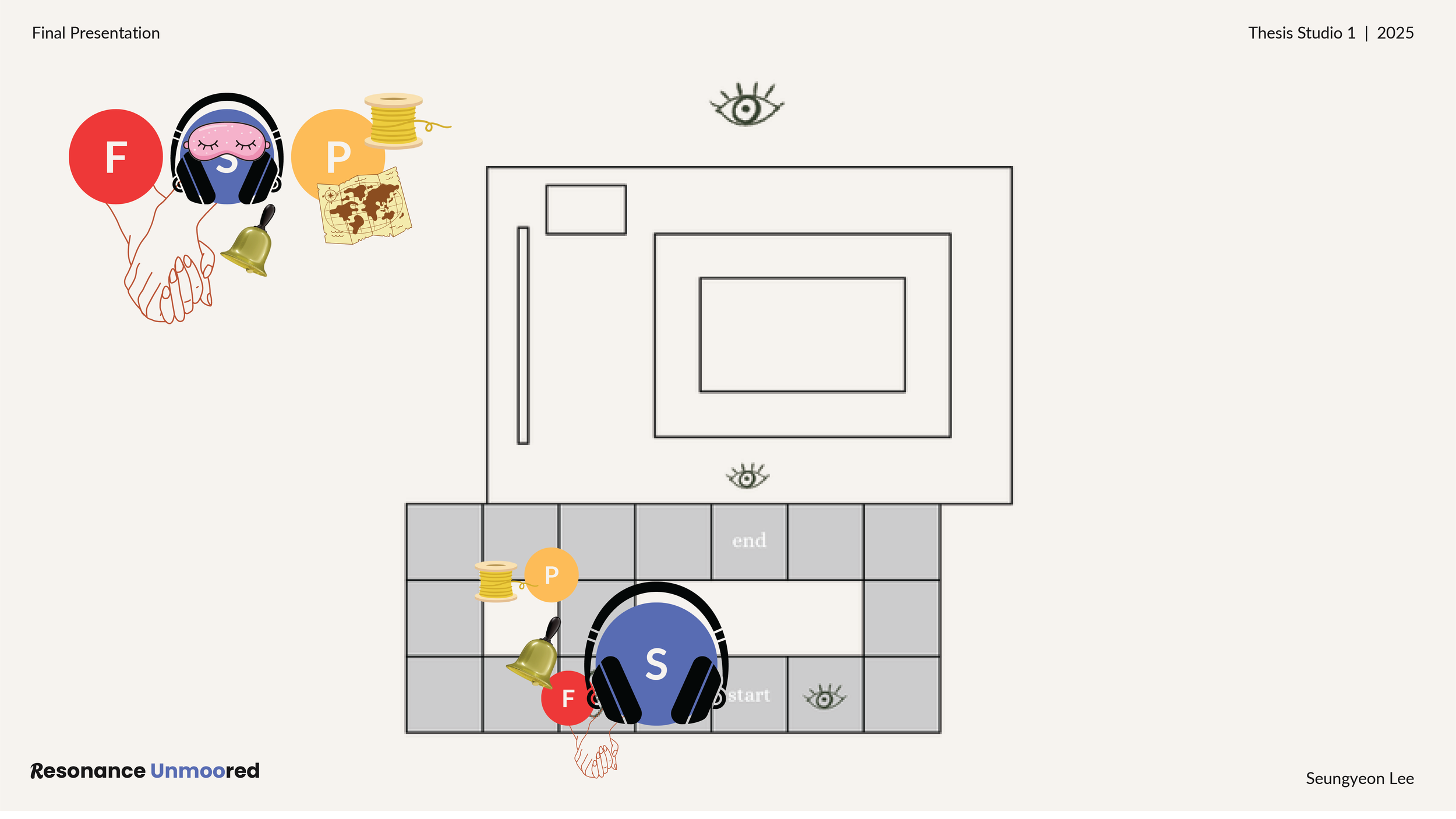
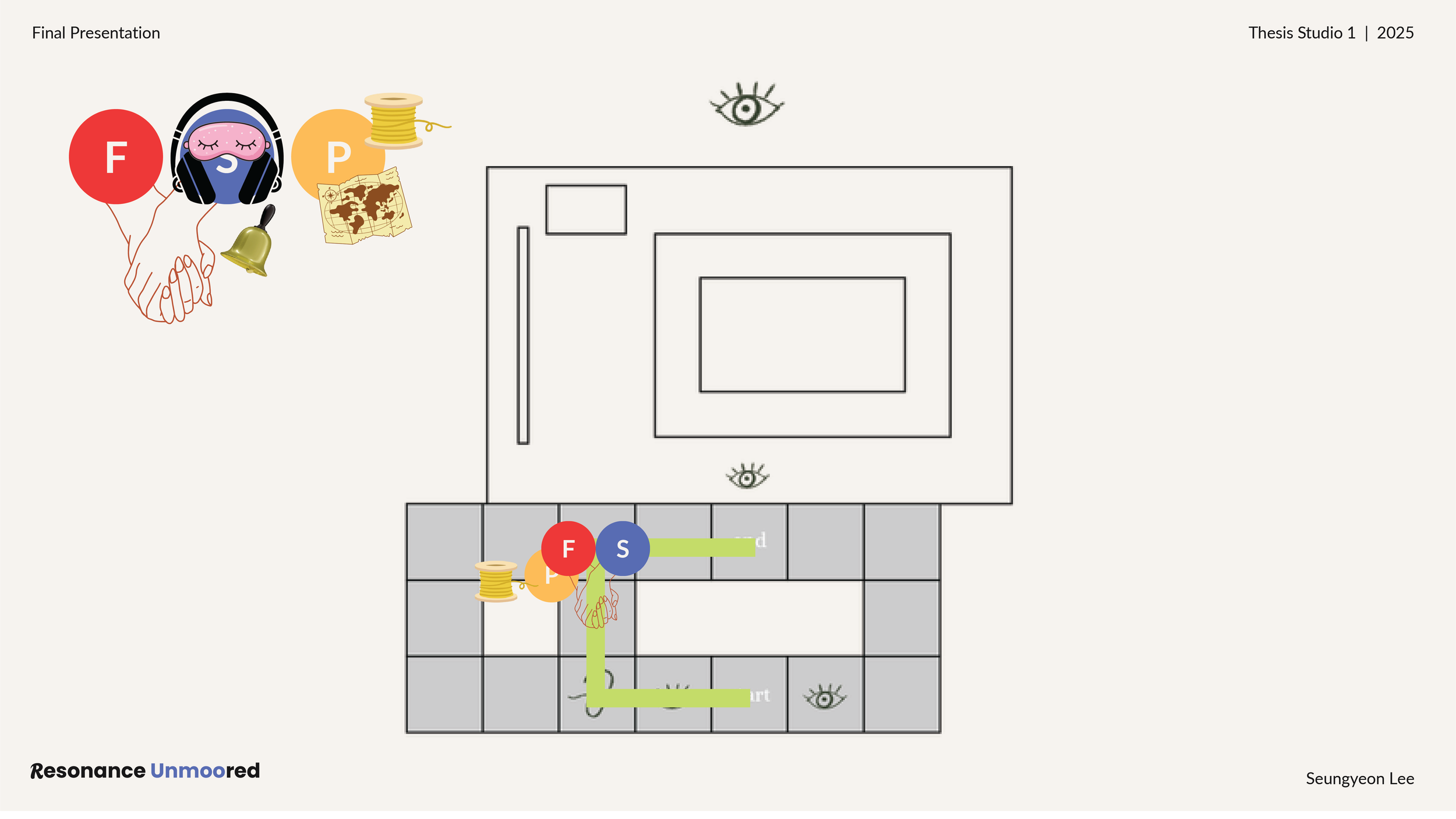
When the group reaches the next decision point, where the ribbon ends, Prism again studies the map and identifies two possible routes.
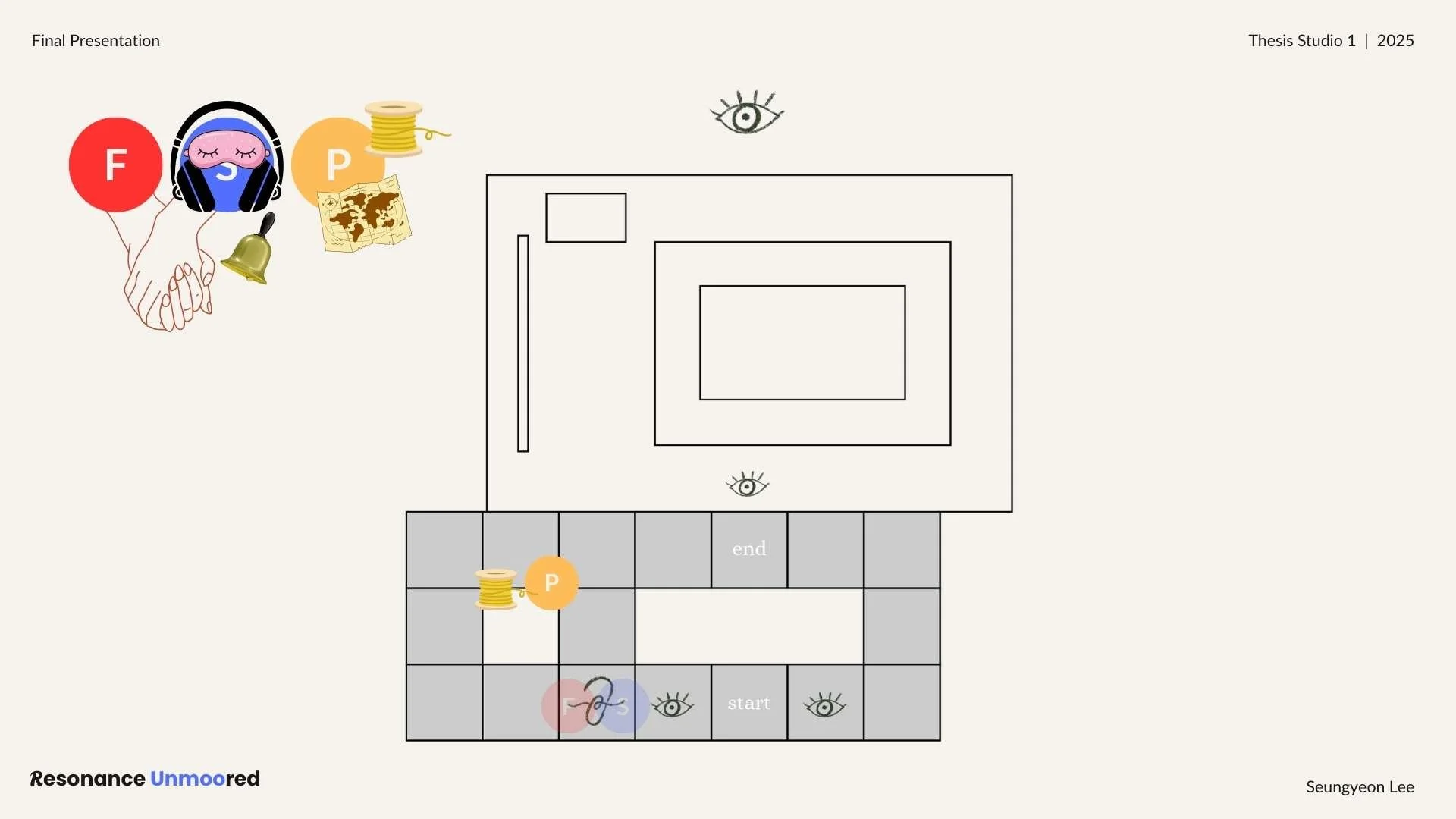
At this location, however, an ear icon indicates that a sonic clue is available. Prism signals this to Foggy (either through gesture or notes), and Foggy will signal this back to Shaded.
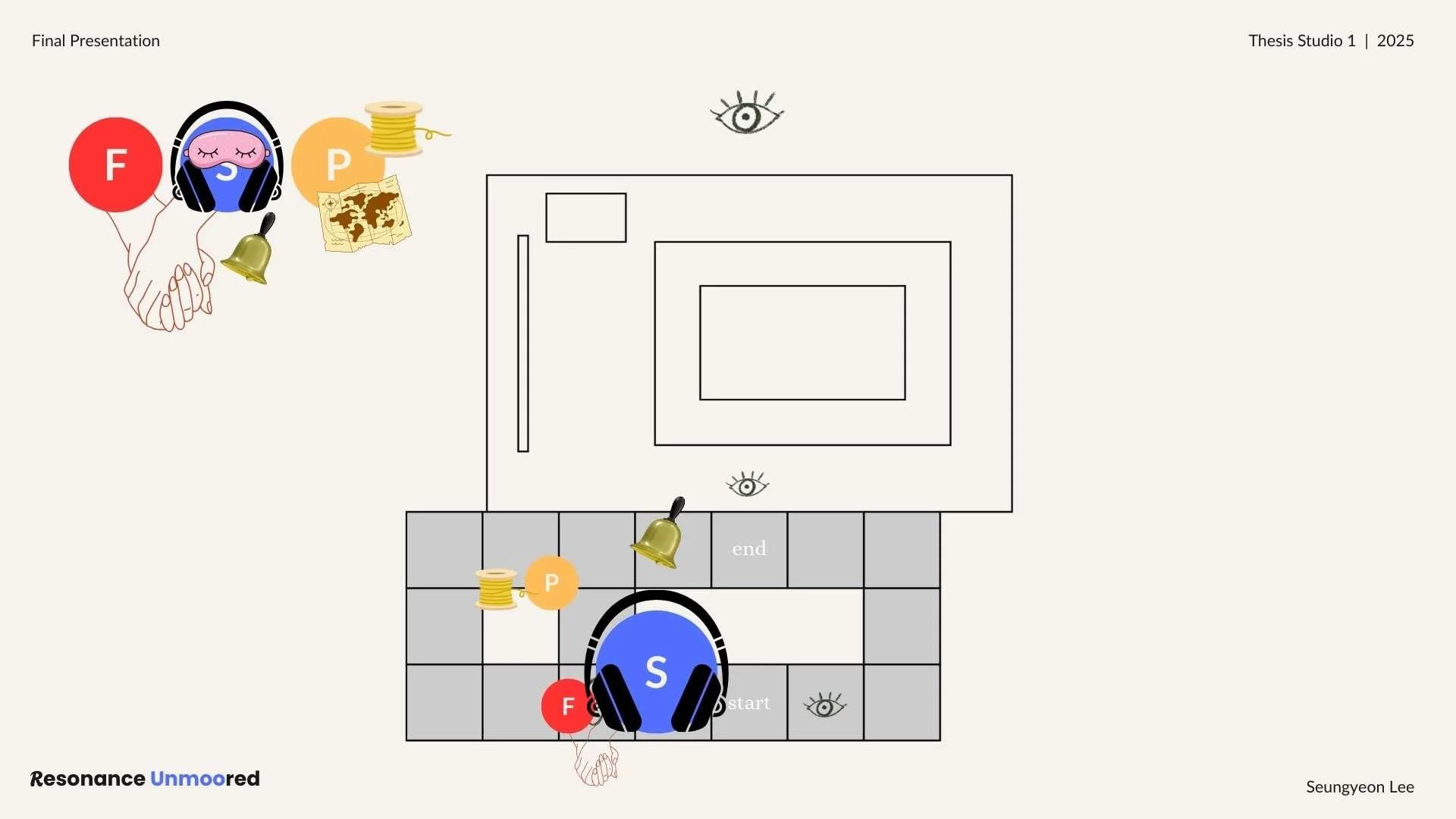
Shaded rings the Liberty Bell in each direction and receives two different sound cues:
● Left: Falling rocks - danger warning
● Forward: birdsong and gentle wind - seems safe
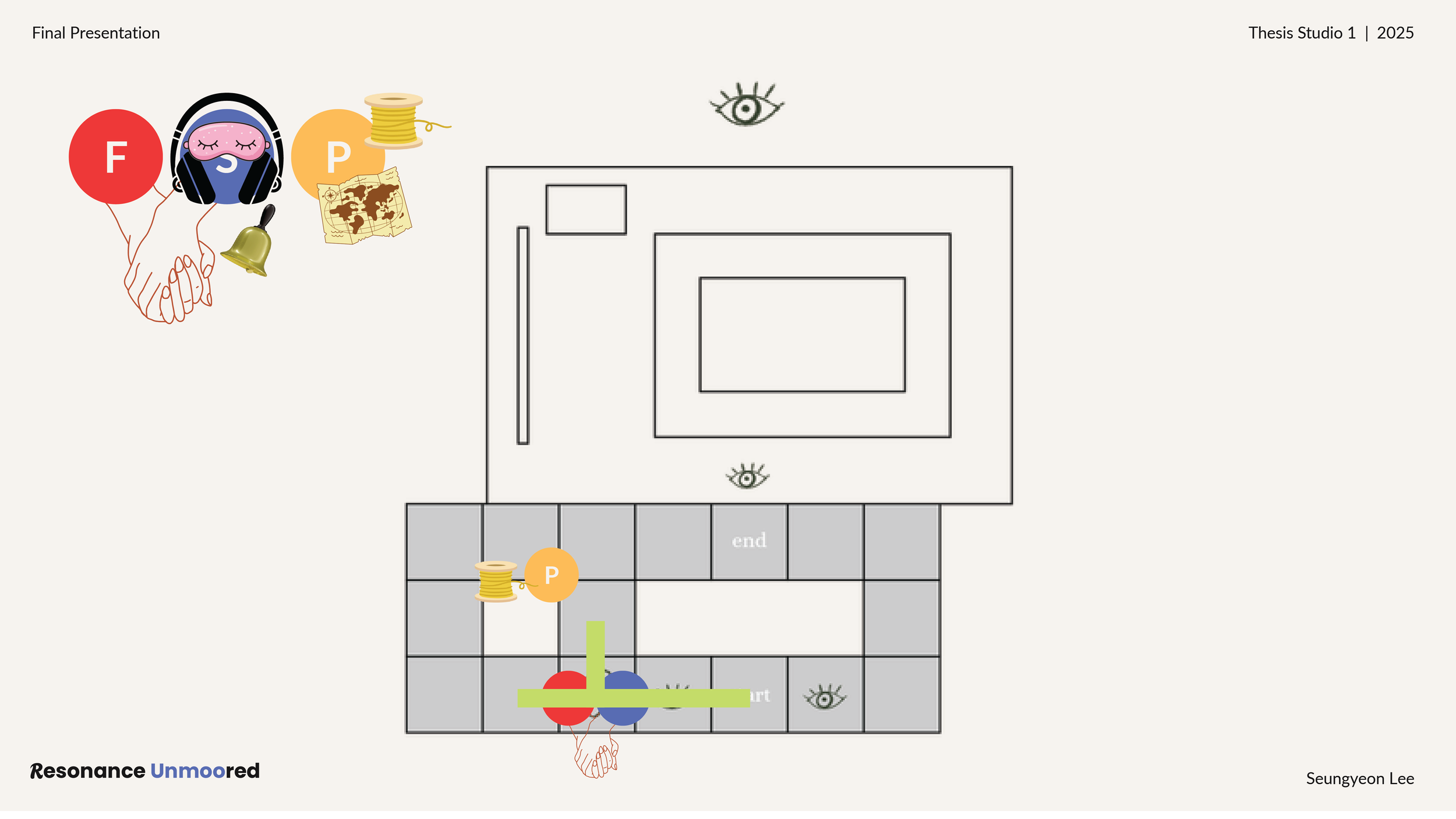
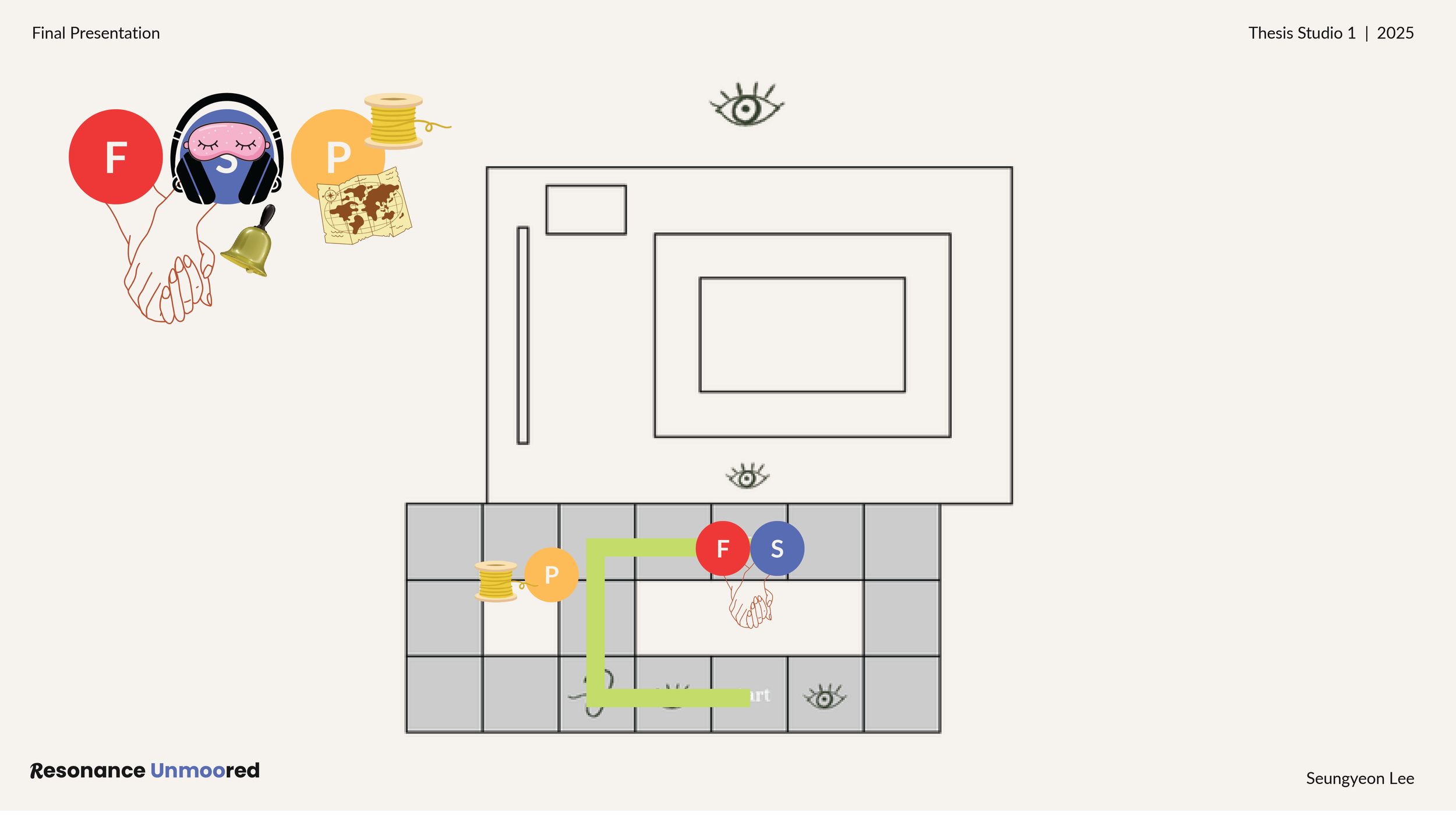
Shaded communicates their interpretation through Foggy, who relays it to Prism. Prism then confirms a safe route and extends the ribbon forward.
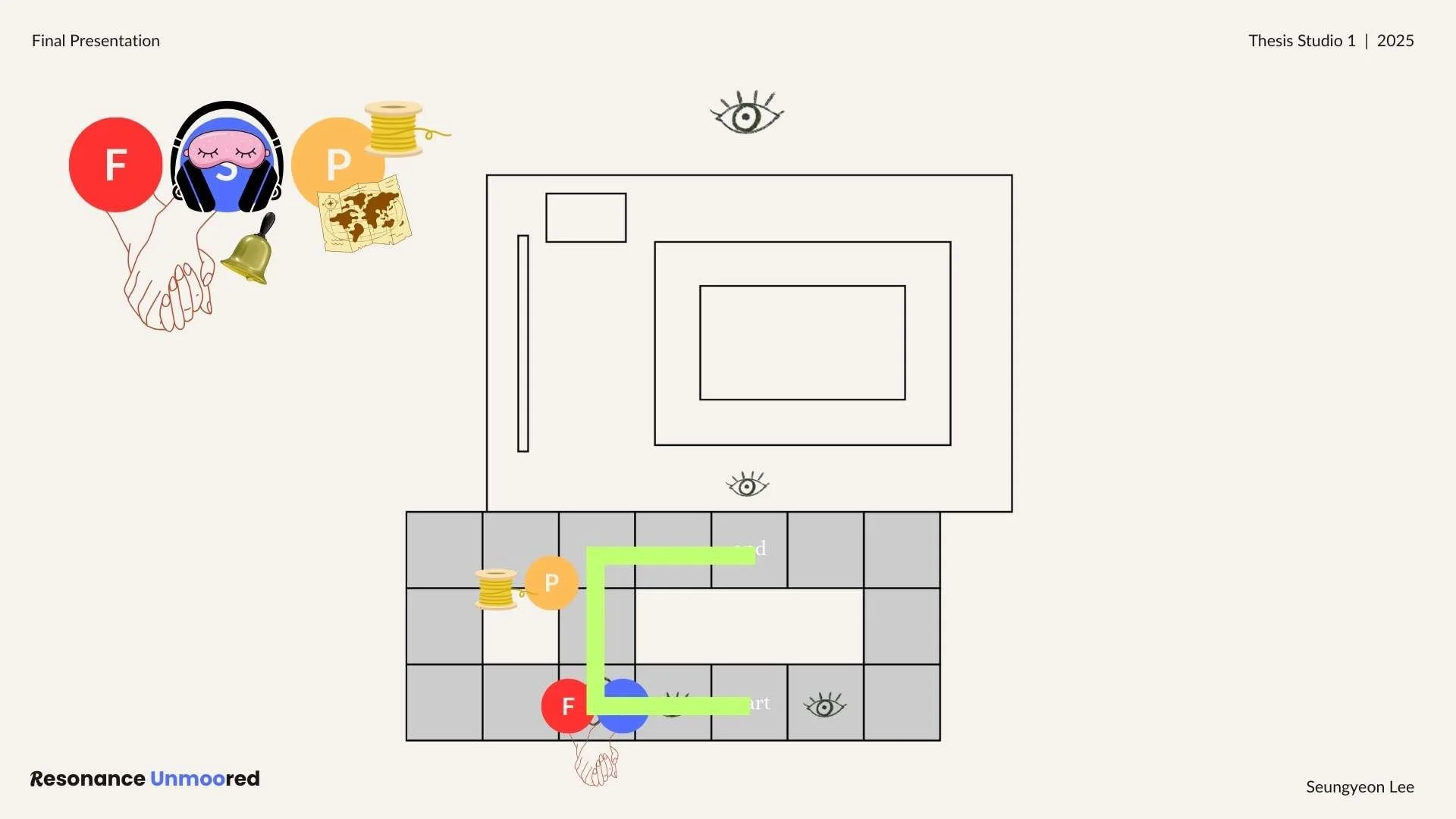
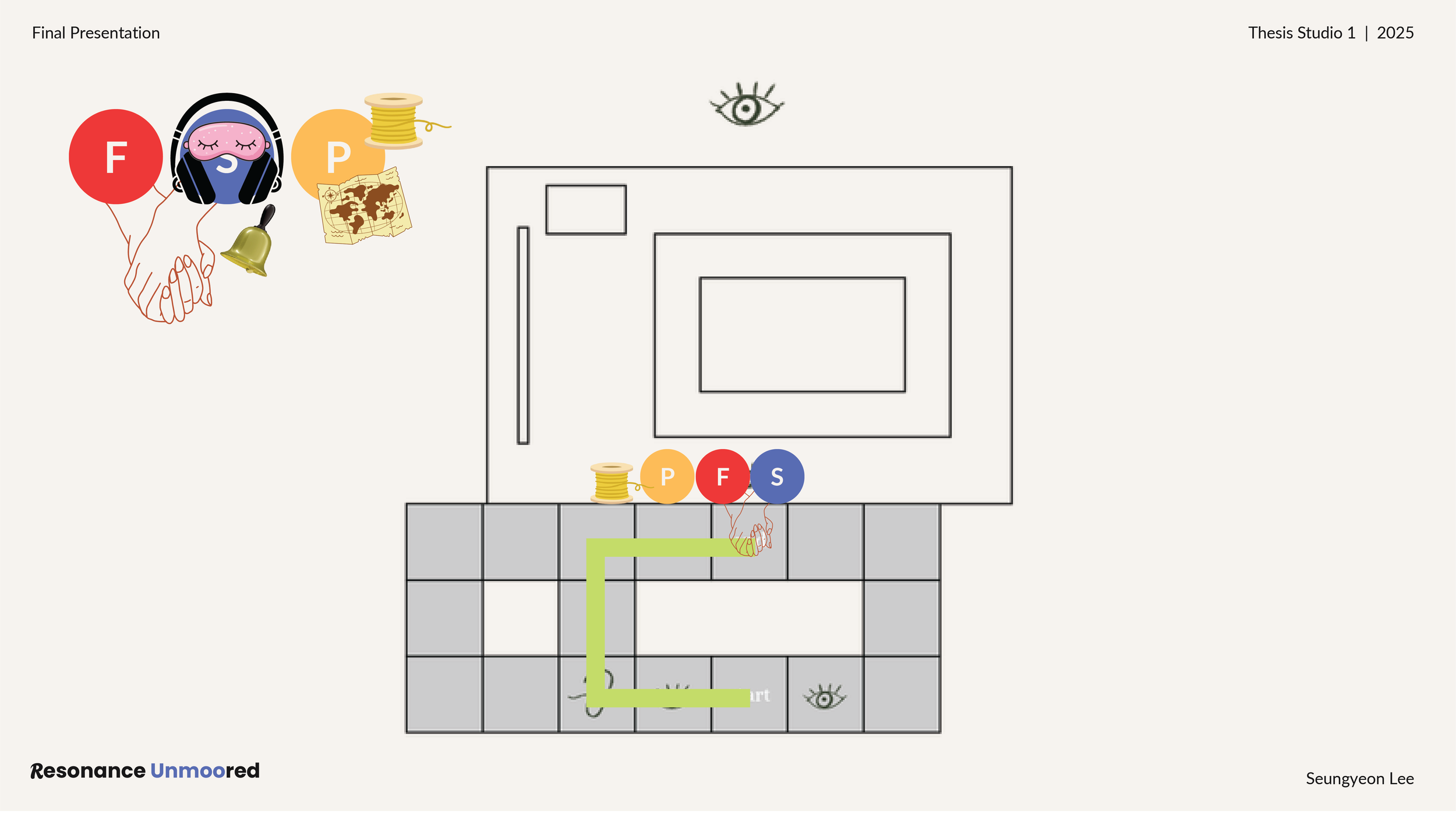
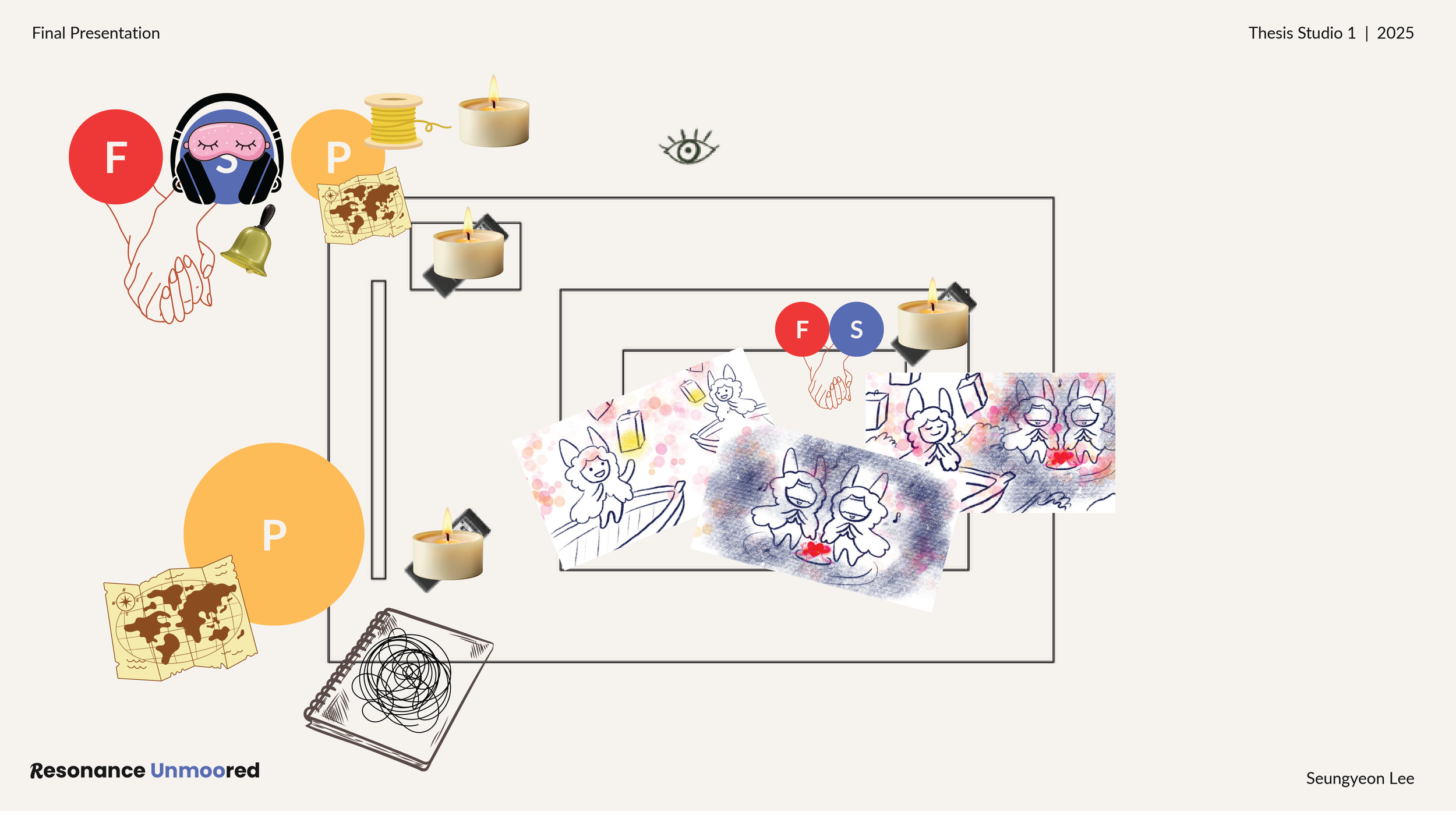
Then the Prism will draw the path like this since there are no other icons drawn on the map, so they can confidently draw the path with the ribbon, and finally, all three players will get to the ending point and enter the room. Eventually, all three players reach the room’s entrance.
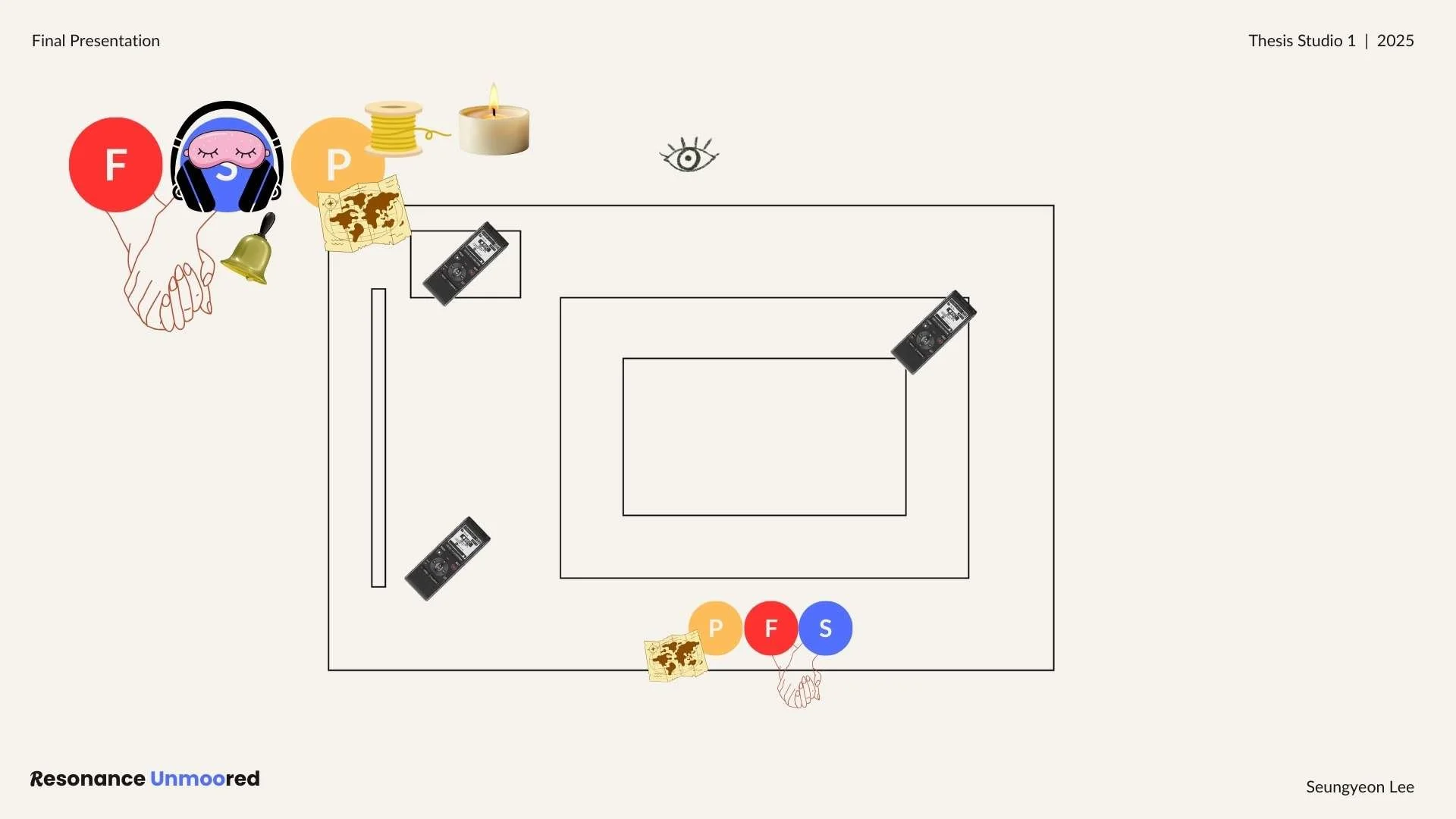
Phase II: The Child’s Room
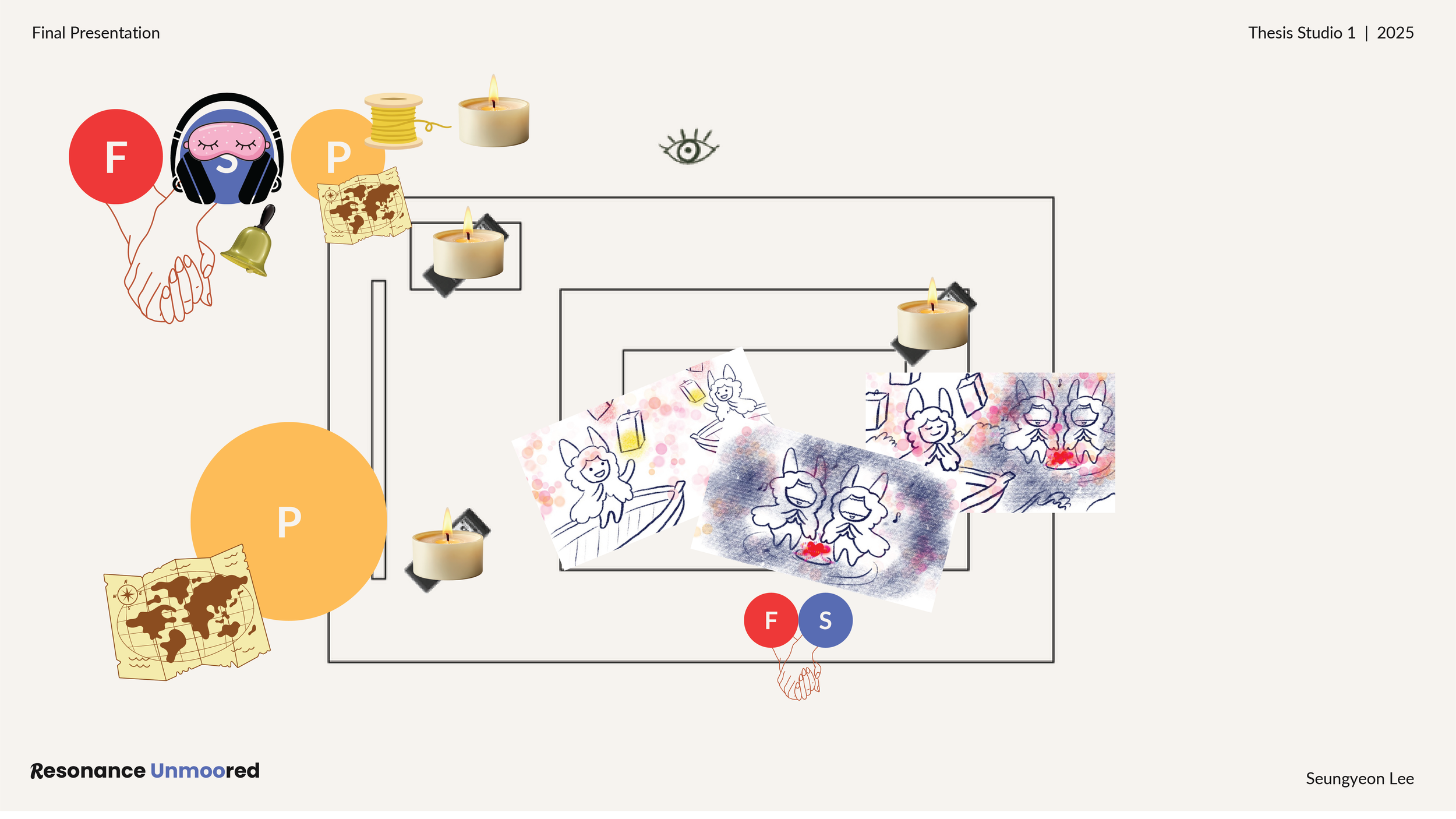
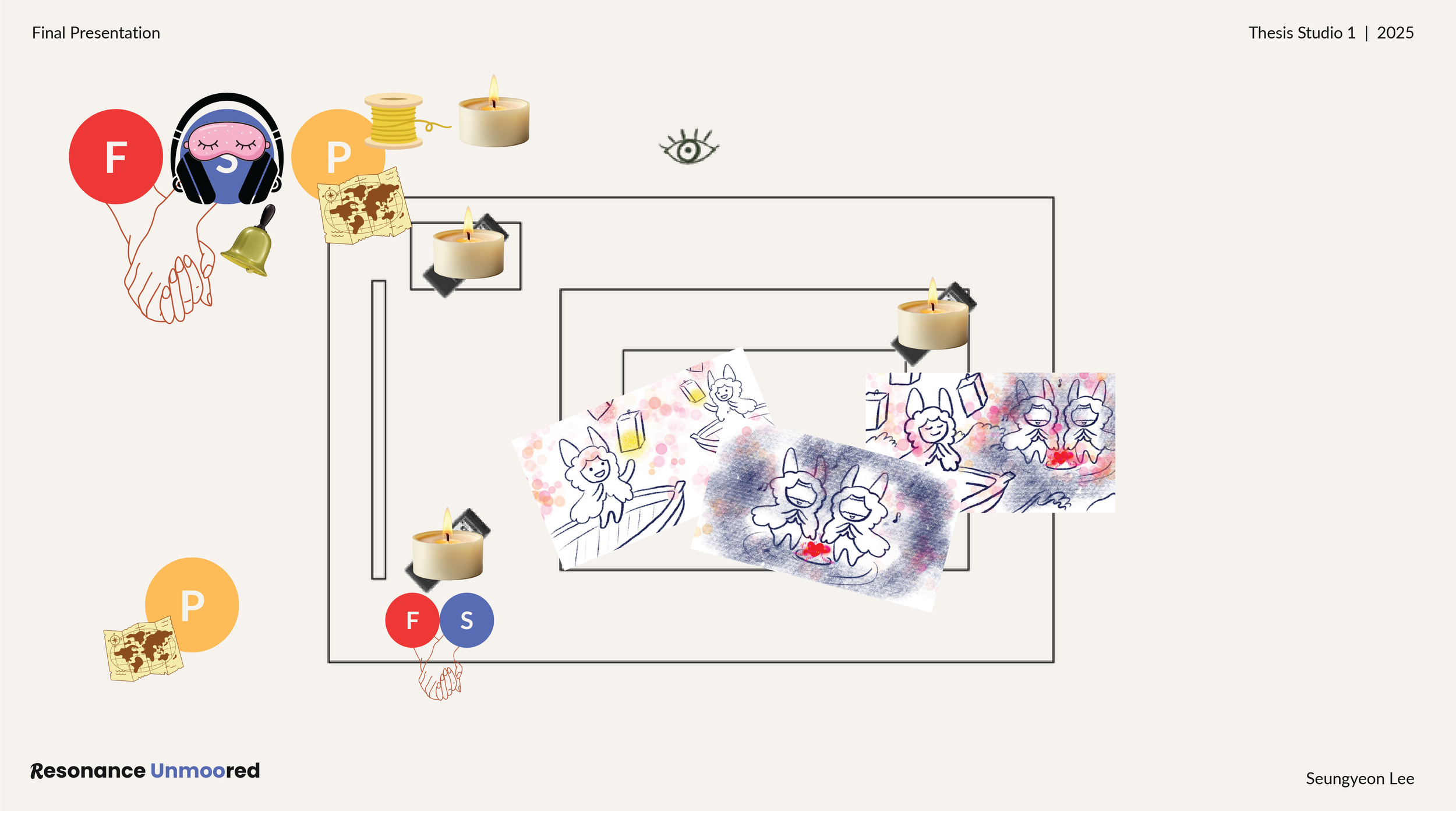
Inside the room, Prism receives a new map marked with the positions of three recorders. They also gain candle lights to mark recorder locations for Foggy.
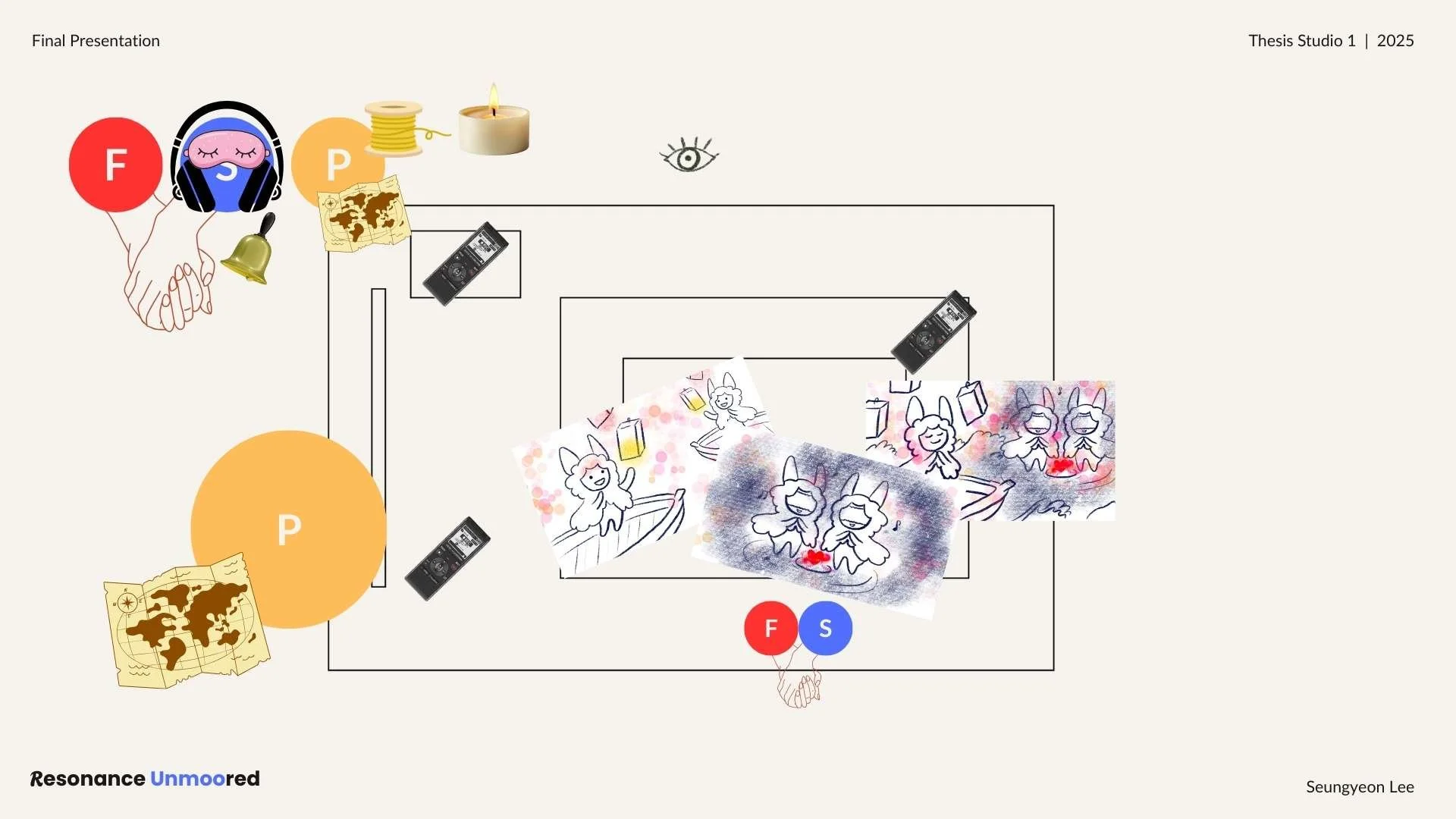
On a table, Prism finds three photographs documenting a child’s eyewitness account. The players must determine which recording among the three recorders matches the truth of the images.
Foggy leads Shaded to each recorder in turn so Shaded can listen to all the recordings one by one.
Meanwhile:
● Shaded explains what they hear to Foggy.
● Prism sketches or annotates details from the photos to compare them with the recordings.
● Foggy conveys this information and compares it with the visual information Prism provided, and identifies the correct recording.
Once the correct recording is identified, Foggy retrieves the candle marking that location and places it into a designated box, sending the verified evidence to the reporter.
And this completes the first full gameplay loop.
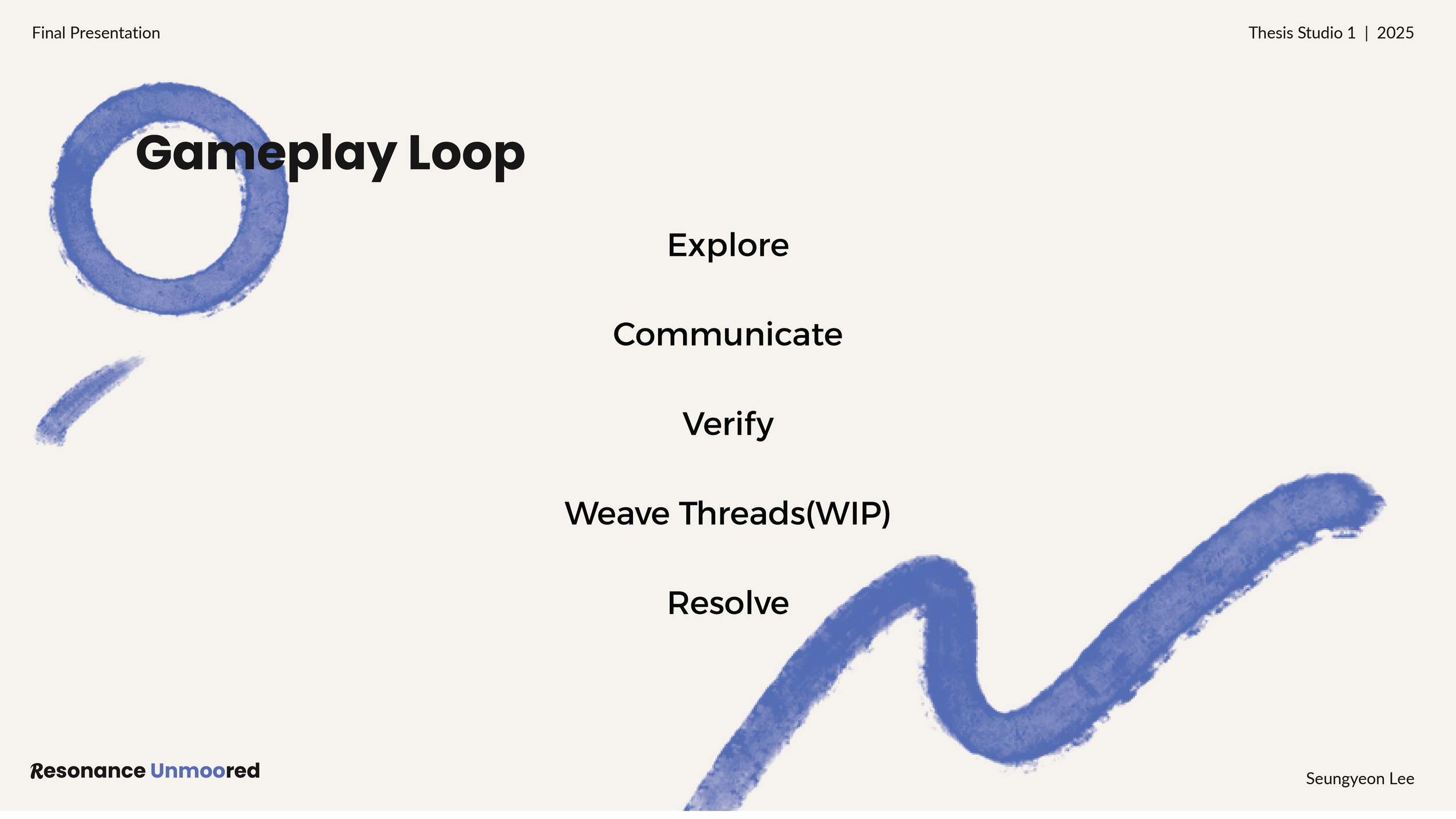
To recapitulate the gameplay loop structure:
1. Navigate with partial information
2. Collect multimodal clues
3. Share and translate sensory data
4. Decide collectively
5. Advance to the next puzzle node
The cooperative gameplay loop in Resonance Unmoored is driven by asymmetric information, sensory constraints, translation, verification, and coordinated movement.
Narration for the Voice Recorders
On the day the great flood came, the people from Prism City did not hear the sound of the approaching waves. It was the night of the festival of falling lights, and everyone was focused on crafting lanterns to fill the sky with brilliance. The people of Shaded City thought the roar of the waves was simply the sound of boats celebrating across the sea. They weren’t hiding in the shadows out of indifference; they were singing prayers into the wind, believing their voices would carry blessings to all three cities. And the people of Prism believed the lights they made would bring warmth and fortune to everyone. We didn’t turn away from the disaster. We were simply…unlucky. All we wished for was good fortune, and we perhaps believed too deeply that light and song alone could keep us safe.
The narration for the voice recordings has 3 different versions, the version above is the correct one that exactly matches the illustration of photos that I’ve made, and the other two versions are blaming one another for neglecting what was happening on the day of the big flood when all repository of Foggy City was washed away. This not only sets the narrative of the game but also conveys how difficult it is to protect our world without genuine care for one another and a sincere effort to understand situations correctly. Among the countless voices and signals we pass by, we must remember that some of them may be calling for our help.